Welcome!
- We have written this to take into account various levels of sales experience and also knowledge with AI, so everyone feels supported where they are at. As such, there may be some areas that are redundant for you – just skip over those, knowing that they may benefit someone with less specific knowledge in this area.
- Note – if ever you feel you need additional information, please reach out to Bella direct. WhatsApp is always fastest to reach her for things that are time sensitive (+44 0752-063-3507) – otherwise via email (bella@bellastjohn.com)
✨ 1. Introduction
Welcome
- We have written this to take into account various levels of sales experience, so everyone feels supported where they are at. As such, there may be some areas that are redundant for you - just skip over those, knowing that they may benefit someone with less specific knowledge in this area.
- Note - if ever you feel you need additional information, please reach out to Bella direct. WhatsApp is always fastest to reach her for things that are time sensitive (+44 0752-063-3507) - otherwise via email (bella@bellastjohn.com)
Contents of this Onboarding Guide
- Introduction
- Getting Set Up and Receiving Your Tracking Link
- Understanding the AI Enablement Suite
- Who the Suite Is For
- The Four Sales Pages and When to Use Each
- How to Position the Suite
- Finding and Approaching Suitable Prospects
- Discovery Questions and Sales Conversations
- Comparing the Suite With Other AI Training
- Handling Common Questions and Objections
- Following Up and Securing the Sale
- Unless it's a "No", it's a "Yes"
- Useful Prompts
You are joining us at a time when organizations across almost every sector are trying to determine how to prepare their people for working effectively and responsibly with artificial intelligence.
Many already have access to AI tools. What they often do not have is a structured way to help their leaders, managers, and employees understand how AI affects their work, decisions, responsibilities, communication, judgment, and relationships.
That is the need the AI Enablement Suite was created to address.
Your role is to identify organizations that may benefit from the Suite, connect with the appropriate decision-makers, understand what they need, and work toward securing the sale.
You do not need to be an AI expert. You do, however, need to become familiar enough with the Suite to explain:
- the organizational problem it solves;
- what the buyer receives;
- how it differs from tools-based or technical AI training;
- why an organization may choose to purchase it rather than develop an entire program internally; and
- which sales page is most appropriate for the prospect.
The sections that follow will give you the knowledge, language, prompts, and practical resources you need.
Your Role
Your role is to find and engage suitable prospective buyers and help move them from initial interest through to a purchase.
Depending on the relationship and the situation, this may include:
- identifying organizations with an immediate or emerging AI training need;
- finding the person most likely to influence or approve the purchase;
- introducing the AI Enablement Suite;
- asking questions to understand the organization’s current position;
- helping the prospect recognize the gap between having AI tools and having an AI-ready workforce;
- directing the prospect to the most relevant sales page;
- answering reasonable questions about the Suite;
- responding to common concerns and comparisons;
- following up appropriately; and
- working toward securing the sale.
This is more than simply posting a link and hoping someone purchases. Your value is in recognizing a genuine organizational need, beginning the right conversation, and helping the buyer understand why the Suite may provide a practical solution.
What Happens After the Sale
We handle:
- payment processing;
- digital delivery of the purchased materials;
- customer communication relating to fulfilment;
- administration of the purchase; and
- the optional 45-minute initial rollout strategy session available to purchasers of the complete Suite.
You are not expected to deliver the training, customize the materials, provide technical implementation services, or manage the customer’s internal rollout unless you independently choose to offer those services through your own business.
We focus primarily on providing and supporting the AI Enablement Suite, so when you introduce it to one of your clients or professional contacts, the relationship remains yours.
If the customer would like additional help with facilitation, customization, implementation, or delivery, we can also connect them with one of our independent delivery partners. This gives the customer access to further support when needed, without taking over your relationship with them.
Your Commission
The program operates on a 50/50 revenue-share basis.
For each qualifying purchase made through your approved tracking link:
- A complete AI Enablement Suite sale at $9,997 generates a commission of $4,998.50.
- An individual training bundle sale at $997 generates a commission of $498.50.
Commission payments are made monthly on the 15th, or on the next business day when the 15th falls on a weekend or public holiday.
To allow time for any payment issues, refunds, or chargebacks to be resolved, each sale has a brief 14-day clearance period before the commission is included in a payment.
This simply means that if a sale is completed close to the 15th, the commission may be included in the following month’s payment rather than the immediate one.
Professional Representation
(this is the part the legal beagles insist we include)
You are an independent commission sales professional, not an employee, agent, or our legal representative.
Please represent the Suite accurately and professionally. This means:
- do not guarantee that a prospect will achieve a particular financial, productivity, compliance, or operational result;
- do not describe features or services that are not included;
- do not present yourself as authorized to alter prices, licenses, terms, or product inclusions;
- do not offer legal, regulatory, technical, financial, or medical advice on our behalf; and
- ask for assistance whenever you receive a question you cannot answer confidently.
There are no guaranteed sales or income levels. Results will vary according to your relationships, prospecting activity, sales ability, follow-up, market conditions, and the needs and purchasing decisions of the organizations you approach.
Your objective is not to pressure organizations into purchasing. It is to identify suitable buyers, have informed conversations, and help them evaluate whether the AI Enablement Suite is right for them.
✨ 2. Getting Set Up, Receiving Your Tracking Link, & Getting Paid
Setting up your account - so you can get paid!
Before you begin introducing the AI Enablement Suite, you must create your free SendOwl account and obtain your unique tracking link.
This will also enable you to present as an Authorized Sales Representative in your correspondence and interactions.
SendOwl is the platform used to track qualifying referrals, attribute purchases, and administer commission payments.
Step 1: Register Through the Official Sign-Up Page
Use the following registration link:
https://dashboard.sendowl.com/programs/17105/join/a9268ed340
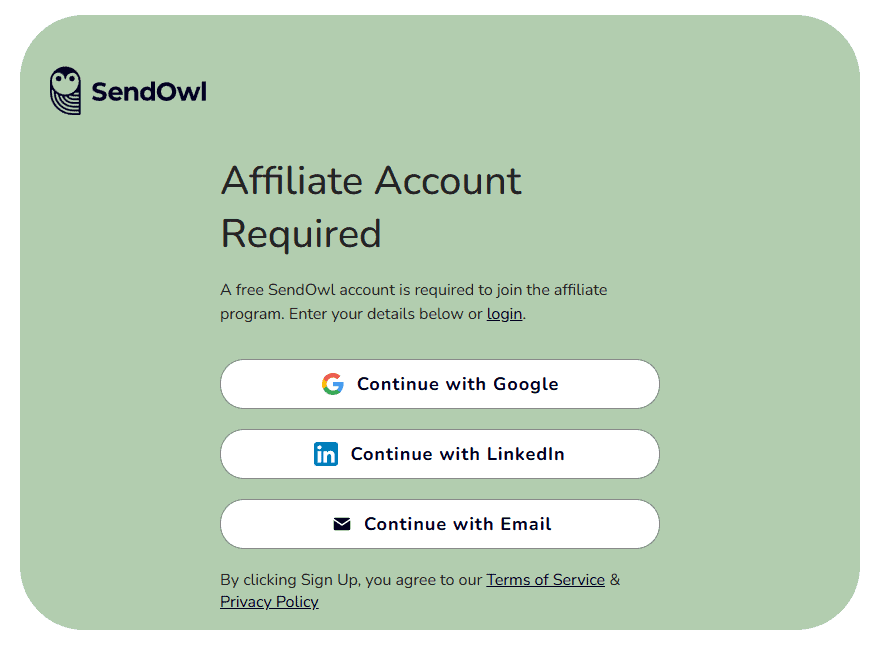
It is important that you register through this specific link so that your account is connected to the correct partner program.
If you already have a SendOwl affiliate account, select the option to log in rather than creating a second account.
Step 2: Create Your Free SendOwl Account
The registration screen will ask for:
- your name;
- your email address;
- a password;
- confirmation of your password; and
- your country.
Complete the security verification, review the SendOwl terms, and submit the form.
There is no charge to create the account.
Use an email address that you check regularly. This will be associated with your partner account and may be used for program and payment-related communication.
Step 3: Access Your Tracking Link
IMPORTANT NOTE: You must use this link for sales through the website so that it is tracked direct to you. Obviously, this is not relevant if we process your client manually with an invoice or similar.
Once your registration is complete, SendOwl will generate your unique partner or affiliate link.
This is not simply a general website address. It contains tracking information that identifies you as the referring salesperson.
When an eligible prospect follows your approved link and completes a qualifying purchase, SendOwl uses that tracking information to attribute the sale and commission to your account.
Do not replace your tracking link with the ordinary website address when sending a prospect to a sales page. A purchase made without your tracking information may not be automatically attributed to you.
Step 4: Save Your Link
Store your tracking link somewhere easy to access, such as:
- your browser bookmarks;
- your customer relationship management system;
- a secure sales reference document; or
- the approved email and message templates you use regularly.
Check carefully when copying and pasting it. Missing characters, spaces, or punctuation may prevent the link from functioning correctly.
Step 5: Test Your Link
Before sharing the link with prospects:
- Copy the complete tracking link.
- Open a private or incognito browser window.
- Paste the link into the address bar.
- Confirm that it opens the correct AI Enablement Suite sales page.
- Confirm that the page loads normally.
You do not need to make a test purchase.
Testing in a private browser window helps you see what a new visitor is likely to see, rather than relying on information already stored in your normal browser session.
The Four Sales Pages
The underlying AI Enablement Suite is the same regardless of which sales page is used. The difference is the positioning, terminology, examples, priorities, and organizational concerns emphasized on each page.
The available pages are:
General organizational page
https://bellastjohninternational.com/aienablement/
Financial services page
https://bellastjohninternational.com/ailiteracy-financial/
Education page
https://bellastjohninternational.com/ailiteracy-education/
Health care page
https://bellastjohninternational.com/ailiteracy-healthcare/
Later in this guide, you will learn how to choose the most appropriate page and position the Suite for each type of prospect.
If you are uncertain about how to direct your tracking link to a particular sector page, contact Bella before sending it.
Protecting Your Commission
The simplest way to protect your commission is to use your approved tracking link consistently.
If an organization tells you it intends to purchase through an invoice, purchase order, bank transfer, or another process that may not involve your tracking link, contact Bella so a manual payment method can be created and the sale attributed to you.
Important note - Do not wait until after an untracked purchase has been completed to raise the issue. Also, simply contacting a prospect does not guarantee a commission. You are responsible for taking that prospect through to a closed sale.
Commission Attribution
Commission is earned only on completed sales that are directly attributable to the Sales Representative.
Sales are attributed through the Sales Representative's unique affiliate link or, where applicable, by manual attribution to the Sales Representative at the time the customer invoice is generated.
Prospecting activity, CRM records, prior contact with a prospective customer, introductions, discussions or follow-up activity do not in themselves establish entitlement to commission.
If a completed sale is not attributed to a Sales Partner through the affiliate tracking system, manual invoice attribution, no commission is payable. It is up to you to ensure your sales are tracked.
Keep Your SendOwl Information Current
Make sure that the following information remains accurate:
- your name;
- your email address;
- your country;
- any required payment information; and
- any tax or administrative information requested by SendOwl.
You are responsible for entering and maintaining your own payment and account details correctly.
Assistance
For questions about the AI Enablement Suite, sales positioning, a prospective buyer, or a referral that may be completed outside the standard online process, contact:
Email: Bella@BellaStJohn.com
WhatsApp Number: +44 0752-0633-507
(Please note - WhatsApp is always fastest if you need something that is time sensitive)
✨ 3. Understanding the AI Enablement Suite
Before you begin approaching prospective buyers, it is important to understand exactly what the AI Enablement Suite is - and what it is not.
The Suite in One Sentence
The AI Enablement Suite is a comprehensive, human-centered AI training foundation that organizations can internally brand, adapt, and deploy without having to build an entire AI literacy and readiness program from scratch.
BRIEF OVERVIEW - for your to say to Client
Right now, your organization is under real pressure to "do something about AI." Leadership wants movement, boards are asking questions, and everyone senses that falling behind on this is not an option. But underneath that pressure sits a quieter problem: your people are stuck. They're anxious, guessing, using AI inconsistently, or quietly avoiding it altogether because no one has actually shown them how to work with it well.
The AI Enablement Suite solves that. It's a complete, done-for-you AI training program that you put your own name on and roll out as if you built it in-house - turning a nervous, uncertain workforce into people who think clearly, ask better questions, and use AI with genuine confidence and good judgment. It addresses the human side of AI, not just the buttons and tools, which is exactly the part most organizations get wrong.
Here’s another vital point - every course was built from real research into what people are actually asking about AI - so it answers the questions your people already have, not the ones someone assumed they might.
Just as importantly, it covers the things your people don't yet know to ask for - how to tell when AI is confidently wrong, what should never be put into it, and where human judgment has to stay in control. These are the elements that separate safe, capable use from quiet, costly mistakes, and they're built in deliberately. All of it is already done: no committees to convene, no blank page to stare at, no twelve-month curriculum project to fund - the strategy, lessons, worksheets, facilitator guidance, and rollout plan exist right now, ready for your team to brand, adapt, and deploy in weeks rather than quarters.
You buy it once and own it for life. One price covers your entire organization - every team, every department, unlimited participants - with a lifetime license to use and adapt the material internally however you need. It's the difference between "we really should train our people on AI" and "our people are trained," without the cost, delay, and effort normally required to get there.
DETAILED EXPLANATION - for your to say to Client
What you're really buying
You're not buying 1,500 lessons. You're buying the outcome those lessons produce: a workforce that is genuinely ready to work with AI. The real value here is that the hard part is already done - the strategy, the writing, the worksheets, the facilitator notes, the rollout planning. All the months of work that normally sit between "we should train our people on AI" and "our people are trained" - that's precisely the part you get to skip.
Built from real questions, not theory
This is not a set of abstract lessons written in a vacuum about what someone assumed a workforce ought to know. Every course was built from real research into the questions people are genuinely asking about AI - the things they're searching for, struggling with, and trying to figure out right now. That means your people aren't sitting through generic theory that skims the surface. They're getting direct, practical answers to the exact concerns already on their minds - which is precisely why the material lands and actually gets used, rather than being politely ignored.
The problem this actually fixes
Among your people, two risky patterns tend to show up. Some hang back - uncertain, cautious, unsure what's safe to put in or what to trust coming out - and their hesitation quietly costs you speed and ground. Others are already diving in without the knowledge or caution to do it well, trusting bad outputs and feeding sensitive information into tools they shouldn't. The first group stalls, the second exposes you, and often neither recognizes the problem yet. This program addresses both - replacing hesitation with confidence and reckless use with sound judgment, so your people are working with AI capably and safely.
The critical things your people don't yet know to ask for
The most important gaps are the ones your people don't even know they have. They know they want better prompts or faster output. What they don't know to ask for is how to spot when AI is confidently wrong, what should never be entered into these tools, where human judgment must stay in control, and how to think critically about an answer that sounds authoritative but isn't. These are the elements that separate safe, capable AI use from quiet, expensive mistakes - and this program builds them in deliberately, covering the essentials your team would never think to request until something has already gone wrong.
Why doing nothing is the expensive option
The cost of this program is small. The cost of an untrained workforce is not. Right now, staff who don't understand AI are making slower decisions, trusting bad outputs, feeding sensitive information into tools they shouldn't, or simply falling behind competitors whose people already know what they're doing. Every month without a real foundation is a month of avoidable risk and lost ground - and that gap compounds quietly until it becomes very visible.
Why the "human side" focus matters
Most AI training teaches tools. Tools change every few months; the ability to think well does not. This Suite is deliberately built around human judgment - clear thinking, better questioning, sound decision-making - so the skills your people gain don't expire the moment a new platform launches. That's what makes adoption actually stick and be sustainable, instead of stalling the moment the novelty wears off.
Why it's genuinely easy to say yes
You brand it as your own, adapt it freely, and use it across your entire organization for life - one price, unlimited people. At under $150 per course for the complete Suite, it costs a fraction of building this internally or commissioning it from a consultancy, and there's no per-seat fee eating into the value as you scale it across teams. It's designed to be an obvious decision, not a difficult one.
What working with you looks like after purchase
You're not handed a pile of files and left alone. You receive the editable materials, the implementation guidance, and a clear 30-day path to get moving - plus for those who purchase then entire Suite, an optional private strategy session with the program developer to help you choose the right starting point for your organization.
The Problem It Solves
Organizations are investing in AI tools and encouraging their people to use them, but access to technology does not automatically create an AI-ready workforce.
Employees and managers may still be uncertain about:
- what AI can and cannot do;
- when and how it should be used;
- how to evaluate AI-generated information;
- where human judgment remains essential;
- how AI affects privacy, security, ethics, risk, and accountability;
- how roles and working practices may change; and
- how to use AI responsibly and practically in everyday work.
At the same time, HR, Learning and Development, leadership, compliance, and operational teams may know that training is needed but lack the time, specialist resources, or internal capacity to create a comprehensive program themselves.
The AI Enablement Suite provides that foundation.
What the Buyer Receives
The complete Suite includes:
- 15 themed AI training bundles
- 75+ courses
- more than 1,500 individual lessons
- action items and reflection exercises throughout the lesson material
- participant worksheets
- facilitator guidance
- manager discussion prompts
- rollout and implementation resources
- a 30-day deployment plan
- editable text-based materials
- a lifetime in-house license
- one optional private 45-minute AI Enablement Strategy Session
The training covers the human, leadership, strategic, operational, ethical, governance, workforce, data, security, risk, communication, implementation, and customer-related aspects of organizational AI adoption.
It's a good idea for you to download the sample course - available from the sales page. This is also available for your potential customers to download.
Please note, this is the training element only and does not include elements such as the manager prompts, suggested roll out plan etc.
The 15 Training Bundles
The complete Suite includes:
- AI Foundations for Business Leaders
- Executive AI Readiness and Strategic Direction
- Human-Centered AI Leadership
- AI Governance, Ethics, and Responsible Use
- AI Risk, Compliance, and Legal Considerations
- AI Workforce Transformation
- Managing Change and Organizational Adoption
- AI Implementation and Integration
- AI, Data, and Business Intelligence
- AI for Operations and Efficiency
- AI for Communication, Collaboration, and Knowledge Work
- AI for Customer Experience and Trust
- AI Innovation and Product Development
- AI Security, Privacy, and Data Protection
- Executive AI Transformation
You can review all the courses in each package on the sales page - it is a good idea to familiarize yourself with the content.
The bundles can be used together as a broad organizational learning library or selected individually to address a particular immediate priority.
What “Ready-to-Deploy” Means
Ready-to-deploy does not mean that every organization must present the materials in exactly the same way.
It means the core work has already been done.
The organization receives the training content and supporting resources needed to begin planning and delivering internal learning. Its team can then decide how the materials should be adapted to suit its own workforce, branding, language, policies, priorities, and learning environment.
The materials can be:
- used substantially as provided;
- edited, shortened, or expanded;
- placed into the organization’s own templates;
- internally branded;
- uploaded into an LMS;
- converted into slides or workbooks;
- used for facilitated workshops;
- incorporated into leadership or manager sessions;
- delivered as self-paced learning; or
- arranged into tailored internal learning pathways.
The Suite is not locked inside an external platform, rigid course design, or predetermined delivery method. The buyer retains control over how the training is presented internally.
Why the Materials Are Text-Based
Some prospects may initially assume that text-based materials are less valuable than finished videos or prebuilt online courses. In practice, the editable format is one of the Suite’s major advantages.
A fixed video or externally hosted course is difficult to change when:
- terminology needs to reflect the organization;
- internal policies or examples need to be added;
- regulations or technology change;
- only part of a lesson is relevant;
- the organization wants to apply its own branding;
- content needs to be moved into an existing LMS; or
- the preferred delivery format differs across teams.
Editable materials give the buyer flexibility and long-term ownership of its internal learning approach.
The Suite provides the intellectual and instructional foundation. The organization chooses how that foundation is presented to its people.
Human-Centered Rather Than Tool-Centered
The Suite is not primarily a course on how to operate a particular AI platform.
Tools change rapidly. Different organizations also use different technologies, systems, and approved applications.
The Suite instead develops the broader capabilities people need regardless of which tools the organization chooses, including:
- clearer thinking;
- better questioning;
- critical evaluation;
- responsible use;
- informed judgment;
- risk awareness;
- leadership capability;
- human oversight;
- communication;
- adaptability; and
- confidence in working alongside AI.
Tool-specific training may still be useful, but it serves a different purpose. Employees may need to know both how to operate an approved tool and how to think, decide, communicate, and act responsibly when using AI.
The AI Enablement Suite addresses the second - and much broader - organizational need.
Practical Rather Than Merely Informational
The Suite is not simply a collection of information about AI.
Lessons include action items and reflection exercises so participants can connect the material to their own responsibilities and working environment.
This is an important note - this is one of the few (if perhaps the only?) AI literacy training that includes action items throughout so the participants can immediately apply what they are learning.
The accompanying worksheets, facilitator guidance, manager prompts, and rollout resources help the organization turn information into conversations, decisions, and practical workplace application.
The Lifetime In-House License
The buyer receives a lifetime license to use, adapt, and internally brand the purchased materials for its own organization.
The materials may be used across its internal departments, teams, branches, business units, leadership groups, or learning environments, with no per-participant charge.
Why the Lifetime In-House License Matters
The lifetime in-house license is one of the Suite’s strongest sales features.
Many training providers charge:
- per participant;
- per course;
- per department;
- per year;
- or through an ongoing subscription.
Those costs can increase significantly as more employees are trained, new people join the organization, or the program expands across additional teams and locations.
With the AI Enablement Suite, the organization makes one purchase and can continue using the materials internally without paying again each time another employee participates.
This gives the buyer:
- predictable costs;
- no recurring license fee;
- no per-user charge;
- no need to repurchase access for new employees;
- the ability to train different teams at different times;
- the freedom to reuse the materials as part of onboarding, leadership development, manager training, or future AI initiatives;
- and the flexibility to expand the program as its needs develop.
Just as importantly, the materials can be adapted and branded so they appear as part of the organization’s own internal learning program.
Rather than employees feeling that they have simply been directed to an external course, the training can carry the organization’s own branding, language, policies, examples, and leadership messages.
This gives the learning greater relevance and credibility. It reinforces the sense that the organization is taking responsibility for preparing its people, supporting them through change, and giving them clear guidance on how AI should be used.
Employees are more likely to see the training as:
- relevant to their work;
- connected to the organization’s expectations;
- supported by leadership;
- part of a wider internal strategy;
- and evidence that the organization is investing in their confidence, capability, and future.
The license also means the organization is not dependent on continued access to an external platform or provider.
It retains a long-term internal training asset that can be adapted, updated, branded, and reused over time.
This is particularly valuable for organizations with:
- large workforces;
- multiple departments;
- several branches or locations;
- regular employee turnover;
- ongoing onboarding requirements;
- or AI training needs that will continue to evolve.
A useful way to explain this is:
You are not simply purchasing access to an external course. You are acquiring a long-term internal learning asset that can carry your organization’s own identity, reflect your expectations, and show employees that you are actively supporting them through the changes AI is bringing.
The larger the organization - and the longer it expects to use the materials - the more significant this value becomes.
Please note, the license does not permit the buyer to:
- resell the materials;
- publish them publicly;
- distribute them outside the licensed organization;
- use them as private-label or PLR content;
- sell training created from the materials to external clients; or
- commercially license the materials to another organization.
The organization’s receipt, invoice, or payment confirmation serves as proof of its license.
Purchase Options
Organizations can purchase:
The Complete AI Enablement Suite - $9,997 USD
This includes all 15 bundles, 75+ courses, more than 1,500 lessons, the accompanying support materials, the lifetime in-house license, and one optional 45-minute strategy session.
The complete Suite is generally the strongest option for organizations seeking to build AI literacy and readiness across multiple teams, responsibilities, or business functions.
An Individual Training Bundle - $997 USD
An individual bundle may suit an organization with one immediate and clearly defined training priority.
For example, it may currently need help specifically with AI governance, workforce transformation, managing change, security, or leadership readiness.
The salesperson’s role is not to force every prospect toward the complete Suite. It is to understand the need and help the buyer identify the most appropriate option.
What Is Not Included
Unless separately agreed, the purchase does not include:
- custom rewriting of the materials;
- development of internal AI policies;
- legal or regulatory review;
- LMS installation or technical setup;
- custom implementation;
- live delivery of the training;
- ongoing consulting; or
- a guarantee of specific organizational results.
Complete Suite purchasers receive one optional 45-minute strategy session to help them identify an appropriate starting point and initial rollout path. This is a focused orientation session, not a custom implementation project.
Organizations that require external delivery or additional implementation support may be introduced to an appropriate independent delivery partner.
✨ 4. Who the Suite Is For
The AI Enablement Suite is designed for organizations that recognize their people need structured AI literacy and readiness training but do not want - or do not have the capacity - to create a complete internal program from the beginning.
The Ideal Buyer
The strongest prospects are generally organizations that:
- are already introducing or exploring AI;
- know employees are using AI, whether formally or informally;
- are purchasing or considering AI tools;
- need managers and employees to make better-informed decisions about AI;
- want a consistent organizational approach rather than fragmented individual learning;
- are concerned about governance, ethics, risk, privacy, security, or responsible use;
- need to prepare employees for changing roles and working practices;
- want to build internal AI learning through HR, L&D, leadership, or compliance;
- have an LMS or internal training system that requires suitable content;
- need to train people across several functions or locations;
- want editable materials they can adapt internally; or
- understand that AI adoption is a people and leadership issue, not only a technology project.
An organization does not need to be technically advanced to benefit.
In some cases, the strongest need exists precisely because the organization is at an early stage and wants to establish sound foundations before AI use becomes widespread.
The People Who Benefit
The Suite is not restricted to technical teams.
Depending on the organization and the bundles selected, it may support:
- executives and senior leaders;
- managers and supervisors;
- HR and Learning and Development teams;
- compliance, legal, privacy, and risk teams;
- operations and administration;
- customer or client-facing employees;
- communications and marketing teams;
- data, security, and technology teams;
- project and change leaders;
- educators and academic leaders;
- clinical and nonclinical health care teams; and
- employees whose work is already being affected by AI.
The content can be used to create different learning pathways for different groups. Not every employee needs to complete every course.
Who Usually Buys It
The person who first recognizes the need may not be the final purchaser.
Likely buyers, decision-makers, or internal champions include:
- Chief Human Resources Officers;
- Human Resources Directors/Managers;
- Learning and Development leaders;
- Training Directors;
- Chief Learning Officers;
- Chief People Officers;
- Chief Executive Officers;
- Chief Operating Officers;
- business owners;
- digital transformation leaders;
- AI or innovation leaders;
- compliance and risk leaders;
- privacy and governance leaders;
- departmental or divisional leaders; and
- sector-specific executives.
In smaller organizations, the owner, CEO, Managing Director, or senior operational leader may be able to make the decision directly.
In larger organizations, several people may be involved, including HR, L&D, IT, compliance, procurement, legal, finance, and executive leadership.
Important Note - although this is an organization-wide license, with similar other programs we have developed, we have found in very large organizations, several different departments wish to purchase the program specifically to brand within their department.
Typical Organizations
Potential buyers may include:
- corporations;
- small and medium-sized businesses;
- professional services firms;
- financial institutions and financial services firms;
- insurance organizations;
- banks and credit unions;
- advisory and investment firms;
- schools;
- colleges and universities;
- private education providers;
- training organizations;
- hospitals and health systems;
- clinics and health care centers;
- nonprofit organizations;
- associations;
- government or public-sector bodies; and
- organizations with distributed branches, departments, or teams.
The key consideration is not simply the organization’s industry. It is whether the organization has a genuine need to prepare its people for responsible and effective AI use.
General Organizational Prospects
Use the general organizational positioning for businesses and organizations that do not fall clearly within financial services, education, or health care.
The central message is:
The organization can build AI literacy and readiness internally without having to create an entire training program from scratch.
The general sales page is suitable for prospects whose priorities may include:
- leadership readiness;
- workforce capability;
- managing change;
- AI governance;
- practical adoption;
- operational improvement;
- customer experience;
- data and security;
- responsible use; or
- building an organization-wide learning foundation.
IMPORTANT NOTE - The product itself remains the same. The separate industry sector pages frame its relevance through the priorities and language of the sector - the content of the program remains the same for every sector - and due to the nature of the program, they can adapt the contents to meet their specific requirements.
Financial Services Prospects
The financial services positioning is appropriate for organizations such as:
- banks;
- credit unions;
- insurance companies;
- insurance agencies;
- investment and wealth-management firms;
- financial advisory practices;
- accounting and finance organizations;
- lending and mortgage businesses;
- fintech companies; and
- other regulated or trust-based financial services firms.
These prospects are likely to be particularly concerned with:
- governance;
- compliance;
- risk;
- privacy;
- data protection;
- security;
- client trust;
- transparency;
- human oversight;
- employee judgment; and
- responsible use across client-facing and operational teams.
Education Prospects
The education positioning is appropriate for:
- K–12 schools and school systems;
- colleges;
- universities;
- private education providers;
- vocational and professional training organizations;
- online learning providers; and
- education-related institutions.
Potential users extend well beyond teaching staff and may include:
- institutional leadership;
- faculty and educators;
- academic administration;
- student services;
- HR and L&D;
- governance and compliance;
- IT;
- operations; and
- other professional staff.
Important concerns may include:
- responsible AI use;
- academic integrity;
- the effect of AI on teaching and learning;
- staff capability;
- governance;
- privacy;
- consistency across departments;
- human judgment;
- student and stakeholder trust; and
- institution-wide readiness.
The Suite should not be positioned merely as training teachers to use AI in the classroom. It supports broader readiness across the institution.
IMPORTANT NOTE: The educational industry sector more than most may be particularly interested in the experience of the developer. The program has been developed by someone with over 30 years of experience in the learning and development arena, and approximately 10 years of experience in the area of artificial intelligence.
Health Care Prospects
The health care positioning is appropriate for:
- hospitals;
- health systems;
- medical centers;
- clinics;
- specialist practices;
- community health organizations;
- aged-care or care-related organizations;
- health care networks; and
- other organizations with clinical and nonclinical teams.
Likely priorities include:
- privacy and data protection;
- responsible AI use;
- governance;
- risk awareness;
- human oversight;
- sound professional judgment;
- patient and community trust;
- workforce readiness;
- operational use of AI; and
- consistent understanding across clinical, administrative, and leadership teams.
The Suite is not clinical AI instruction and should never be positioned as medical training or as a substitute for clinical, legal, privacy, or regulatory guidance.
It provides the broader organizational learning foundation needed to help people understand and navigate AI responsibly in a health care environment.
The Key Qualification Question
When considering whether an organization is a suitable prospect, ask:
Does this organization need to prepare its people to understand, evaluate, use, manage, or lead with AI - and would a ready-made, editable internal training foundation save it substantial time and effort?
When the answer is yes, the organization may be a strong prospect for the AI Enablement Suite.
✨ 5. The Four Sales Pages and When to Use Each
The AI Enablement Suite is presented through four different sales pages:
- the general organizational page;
- the financial services page;
- the education page; and
- the health care page.
The product, pricing, inclusions, and license remain the same.
The purpose of the sector-specific pages is to help the prospect see the relevance of the Suite through the language, priorities, risks, responsibilities, and operating environment of its own sector.
Choosing the right page can make the difference between a prospect seeing the Suite as “general AI training” and recognizing it as a practical response to a problem already affecting the organization.
The Videos on Each Page
✨ These will do a lot of the selling for you - in addition to the testimonial.
The General Organizational Page
Use for: businesses, nonprofits, associations, professional services firms, government-related organizations, and any prospect that does not fall clearly within financial services, education, or health care.
Sales page:
https://bellastjohninternational.com/aienablement/
The general page is also appropriate when:
- the organization operates across several sectors;
- you are unsure which sector framing is most relevant;
- the prospect’s primary interest is broad workforce readiness;
- the organization is focused on leadership, change, governance, productivity, or responsible AI use;
- you are speaking with a consultant, adviser, association, or intermediary whose clients span multiple industries; or
- the initial conversation is about AI readiness generally rather than a sector-specific concern.
Central Positioning
The general page positions the Suite as a complete internal AI training foundation that enables an organization to prepare its people without building an entire program from scratch.
Priorities to Emphasize
Depending on the prospect, emphasize:
- organization-wide AI readiness;
- leadership capability;
- responsible use;
- employee judgment;
- practical workplace application;
- workforce change;
- governance and risk;
- customer trust;
- data and security;
- operational readiness;
- adaptability; and
- the ability to tailor the material internally.
Suitable Opening
Many organizations are investing in AI tools without giving their people a consistent foundation for using them well. The AI Enablement Suite provides the training and supporting resources needed to build that capability internally, without having to develop an entire program from the beginning.
The Financial Services Page
Use for: banks, credit unions, insurers, insurance agencies, financial advisers, wealth-management firms, mortgage and lending businesses, accounting firms, fintech companies, investment firms, and other financial services organizations.
Sales page:
https://bellastjohninternational.com/ailiteracy-financial/
Financial services prospects often operate in environments where trust, oversight, data, risk, and regulatory responsibility are central to every decision.
The Suite should therefore be positioned as a way to build practical AI capability across the organization while supporting responsible judgment and consistent understanding.
Priorities to Emphasize
- governance;
- compliance awareness;
- privacy;
- data protection;
- security;
- client trust;
- risk management;
- transparency;
- accountability;
- human oversight;
- responsible use;
- leadership readiness; and
- consistency across client-facing and operational teams.
Suitable Opening
Financial services organizations are adopting AI in an environment where trust, risk, privacy, judgment, and accountability matter enormously. The AI Enablement Suite helps build a shared foundation across leadership, client-facing teams, operations, HR, compliance, and other functions.
Do Not Overstate
Do not describe the Suite as:
- regulatory compliance training;
- legal advice;
- a guarantee of compliance;
- cybersecurity certification;
- technical training for financial AI systems; or
- a substitute for the organization’s legal, risk, privacy, or compliance specialists.
It supports broader workforce literacy and responsible organizational readiness.
The Education Page
Use for: schools, school systems, colleges, universities, vocational institutions, private education providers, online learning organizations, and professional training organizations.
Sales page:
https://bellastjohninternational.com/ailiteracy-education/
AI in education is often discussed only in relation to students, assignments, or classroom tools. The Suite addresses a much wider need.
Education institutions also need to prepare:
- senior leaders;
- faculty and teaching staff;
- academic administrators;
- student services;
- HR and L&D;
- governance teams;
- compliance teams;
- IT;
- operations; and
- other professional staff.
Priorities to Emphasize
- institution-wide readiness;
- responsible AI use;
- academic integrity;
- staff capability;
- governance;
- privacy;
- human judgment;
- consistency across departments;
- leadership readiness;
- student and stakeholder trust;
- changing roles and practices; and
- the need for a shared institutional foundation.
Suitable Opening
AI is already affecting teaching, learning, administration, student services, leadership, and institutional operations. The AI Enablement Suite helps education providers build a consistent foundation across the whole institution - not only among teachers or students.
Do Not Narrow the Positioning
Avoid presenting the Suite as simply:
- a classroom AI course;
- teacher training;
- student prompt training;
- an academic integrity course;
- a curriculum for teaching AI as a subject; or
- software training for a particular education platform.
Those may be part of an institution’s broader strategy, but the Suite addresses organization-wide literacy and readiness.
The Health Care Page
Use for: hospitals, health systems, clinics, medical centers, specialist practices, community health organizations, aged-care organizations, health networks, and organizations with clinical and nonclinical health care teams.
Sales page:
https://bellastjohninternational.com/ailiteracy-healthcare/
Health care prospects are likely to be especially sensitive to privacy, trust, risk, professional judgment, and the need for human oversight.
The Suite should be positioned as a broad organizational readiness foundation - not as clinical instruction.
Priorities to Emphasize
- patient and community trust;
- privacy;
- data protection;
- responsible use;
- human oversight;
- sound judgment;
- governance;
- workforce readiness;
- leadership capability;
- risk awareness;
- consistent understanding across clinical and nonclinical teams; and
- responsible adoption across operations and administration.
Suitable Opening
AI is beginning to affect both clinical and nonclinical work, but access to technology does not ensure that people understand how to use it responsibly. The AI Enablement Suite provides a practical foundation across leadership, administration, operations, and relevant workforce groups.
Do Not Overstate
Do not describe the Suite as:
- clinical AI training;
- medical education;
- patient-care instruction;
- diagnostic training;
- health care compliance certification;
- privacy or regulatory advice; or
- a substitute for professional clinical judgment.
When a Prospect Fits More Than One Page
Some organizations may fit more than one sector.
Examples include:
- a university with a medical school or teaching hospital;
- a financial education provider;
- an insurance organization with an internal training academy;
- a health care association;
- a financial services consultancy;
- a professional education provider serving regulated sectors; or
- a technology company whose clients include financial or health care organizations.
Choose the page that reflects the prospect’s primary identity and strongest immediate concern.
Ask:
Which context will make this organization most quickly recognize the problem and the relevance of the solution?
For example:
- A teaching hospital may respond most strongly to the health care page if privacy, patient trust, and clinical governance are the dominant issues.
- A university leadership team may respond more strongly to the education page if the concern is institutional readiness across faculty and administration.
- An insurance training provider may need the general page if it is considering the Suite for its own workforce, or the financial page if its core concern is insurance-sector readiness.
When uncertain, use the general organizational page rather than forcing a sector fit that does not feel natural.
✨ 6. How to Position the Suite
Positioning is the way you help a prospect understand:
- what the Suite is;
- why it matters;
- why it may be relevant now;
- how it differs from other options; and
- why it may be worth purchasing.
Good positioning is not a list of features.
It connects the organization’s situation to the value of the Suite.
The Core Position
The central position of the AI Enablement Suite is:
A comprehensive, editable AI literacy and readiness foundation that enables organizations to prepare their people without developing an entire internal program from scratch.
This statement contains the major points of difference:
- comprehensive: it goes well beyond a short introductory course;
- editable: the buyer can adapt the material to its own organization;
- AI literacy and readiness: it addresses broader capability, not merely tool operation;
- internal foundation: it becomes part of the organization’s own learning approach; and
- without starting from scratch: it saves substantial development time and effort.
Lead With the Problem, Not the Product
Do not begin by reciting the number of bundles, courses, lessons, or worksheets.
Those details matter, but only after the prospect understands the problem.
Begin with the gap the organization is facing.
For example:
Your people may already have access to AI, but that does not mean they have a shared understanding of how to use it responsibly, evaluate its output, or know where human judgment is still essential.
Or:
Many L&D and HR teams know they need AI training, but creating a complete program internally can consume months of research, writing, instructional design, review, and coordination.
The product details then become evidence that the Suite solves the problem.
✨ Both Washington DC and Texas have already made AI literacy training mandatory in some areas, and in the EU, AI literacy training has already been made a legal requirement for many organizations.
Most organizations are investing in AI without giving their people the skills, judgment or confidence to use it well. The ‘AI Enablement Suite’ provides the training, action items, facilitator resources, and practical tools needed to build workforce-wide AI capability – without having to create an entire program from scratch.
Position It as a Foundation
The Suite is not intended to replace every other form of AI training an organization may ever need.
It provides the broad foundation on which other training can sit.
An organization may still choose to provide:
- training on approved tools;
- technical instruction;
- role-specific workshops;
- policy briefings;
- cybersecurity training;
- legal or compliance updates;
- live facilitation; or
- specialist consulting.
The Suite helps ensure these activities are not occurring in isolation.
A useful explanation is:
Tool training teaches people where to click. The AI Enablement Suite addresses the broader capabilities they need to use AI thoughtfully, responsibly, and effectively in their work.
Position It as an Alternative to Building From Scratch
One of the strongest sales positions is the work the organization does not have to undertake.
Creating a comprehensive internal program can involve:
- researching a rapidly changing subject;
- determining what different employees need to know;
- creating a curriculum;
- writing lessons;
- developing activities and worksheets;
- preparing facilitator resources;
- creating manager discussion materials;
- organizing rollout plans;
- reviewing the content with internal stakeholders;
- adapting it to different audiences;
- and continually deciding what has been missed.
The Suite gives the organization a substantial starting foundation.
Do not claim that the organization will have no work to do. It will still need to determine:
- its priorities;
- which content to use;
- how to align the material with its policies;
- which groups should receive which training;
- how the material will be delivered; and
- who will oversee the rollout.
The accurate position is:
The organization avoids creating the underlying training foundation from a blank page, while retaining control over how it is adapted and delivered.
Position It as Internal Ownership
Many AI training options depend on:
- an external trainer;
- an annual subscription;
- a hosted learning platform;
- per-user fees;
- fixed videos;
- a course that cannot be edited; or
- continuing access to an outside provider.
The Suite follows a different model.
The buyer receives editable materials under a lifetime in-house license.
This means the organization can:
- adapt the training;
- apply its own branding;
- align the content with internal policies;
- use its own facilitators;
- place the material into its LMS;
- create different learning pathways;
- reuse the material internally; and
- update the presentation as its needs evolve.
The organization is not purchasing temporary access to a course library. It is acquiring a long-term internal training asset.
Position the Text-Based Format as Flexibility
Never apologize for the materials being text-based - it is highly intentional that they are presented in this format.
The correct position is that the content has been intentionally provided in an editable form so the buyer is not locked into someone else’s branding, platform, videos, voice, examples, or delivery format.
A suitable response is:
The materials are text-based because they are designed to become part of the organization’s own learning environment. A fixed video is almost impossible to update, rebrand, or align with internal policy - and quickly appears dated. Editable content gives the organization far greater control.
The organization may turn the content into:
- branded PDFs;
- slides;
- workbooks;
- LMS modules;
- live workshops;
- manager-led discussions;
- self-paced learning;
- internal videos; or
- blended learning pathways.
IMPORTANT NOTE: We are happy to help and give them guidance if needed on how to repurpose the materials.
Position the Scale of the Suite Carefully
The complete Suite contains 75+ courses and more than 1,500 lessons.
This demonstrates depth, but it can also sound overwhelming if presented poorly.
Do not imply that every employee must complete all the material.
Instead explain:
The breadth gives the organization options. It can select the courses and lessons relevant to each role, team, or stage of its AI journey rather than forcing everyone through the same program.
The Suite is a learning library and implementation foundation, not one enormous course that must be completed from beginning to end.
Position the Full Suite Versus Individual Bundles
The complete Suite is generally best for an organization that:
- needs training across several functions;
- expects its AI needs to develop over time;
- wants a broad organizational foundation;
- has different audiences requiring different learning pathways;
- wants to avoid purchasing multiple bundles separately; or
- is approaching AI as a strategic workforce issue.
An individual bundle may be appropriate when:
- the organization has a very specific immediate need;
- the budget currently supports only one priority;
- a department is testing the material before considering broader adoption; or
- the prospect genuinely requires only one area of training.
Do not weaken the offer by recommending an individual bundle too quickly.
First determine whether the stated issue is truly isolated.
For example, a prospect may initially ask about governance but also reveal concerns about leadership, employee use, privacy, change, and implementation. That indicates a broader need better suited to the complete Suite.
Position the Price in Context
The complete Suite is priced at $9,997 USD - that works out to be less than $150 per course - not per participant!
Avoid presenting the price as a standalone number without context.
Its value should be considered against:
- the time required to research and develop comparable material;
- the cost of instructional design;
- the cost of hiring consultants or curriculum developers;
- the number of courses included;
- the absence of per-user charges;
- the ability to use the material across the organization;
- the lifetime in-house license;
- the ability to edit and internally brand the content; and
- the long-term value of having an internal learning foundation.
A useful explanation is:
The buyer is not purchasing one workshop or one short course. It is acquiring a broad internal training foundation that can be adapted and used across multiple teams without per-participant fees.
Do not invent an ROI figure or promise that the Suite will save a specific amount.
Position It as Human-Centered
The Suite is based on the understanding that successful AI adoption depends on people, not only platforms.
Technology may be purchased quickly. Workforce capability takes more thought.
The Suite addresses questions such as:
- Can employees evaluate AI-generated information?
- Do managers know when human oversight is essential?
- Are teams aware of privacy, bias, security, and accountability?
- Can leaders guide people through changing roles and expectations?
- Is there a shared understanding of responsible AI use?
- Are employees confident enough to engage with AI without becoming overreliant on it?
This is often the most important distinction when the prospect is comparing the Suite with tools-based training.
Position It as Practical, Not Academic
Although the Suite is comprehensive, it should not be presented as theoretical or academic study.
Its purpose is to help people apply AI-related thinking to real organizational work.
Emphasize:
- reflection exercises;
- action items;
- manager prompts;
- facilitated discussion;
- workplace application;
- implementation resources; and
- the ability to connect the material to the organization’s own policies and priorities.
A suitable phrase is:
The objective is not simply for employees to know more about AI. It is to help them make better decisions about how AI should - and should not - be used in their work.
Use the Prospect’s Language
Once you understand the prospect’s priorities, describe the Suite using language that reflects those priorities.
A bank may respond to:
- risk;
- governance;
- client trust;
- oversight; and
- responsible use.
A university may respond to:
- institutional readiness;
- academic integrity;
- faculty capability;
- governance; and
- consistency across departments.
A health care organization may respond to:
- privacy;
- professional judgment;
- patient trust;
- human oversight; and
- workforce readiness.
A general business may respond to:
- leadership capability;
- workforce change;
- operational readiness;
- responsible adoption; and
- avoiding fragmented AI use.
Do not change the facts of the product. Change the emphasis.
Avoid Fear-Based Selling
AI creates legitimate concerns, but the Suite should not be sold by frightening prospects.
Avoid statements such as:
- “Your organization will be left behind.”
- “You are at serious risk if you do not buy this.”
- “Your employees are probably exposing confidential information.”
- “AI will replace your workforce.”
- “You will be noncompliant without this training.”
Instead, use measured language:
As AI use grows, organizations need a clearer and more consistent approach to helping people understand both its opportunities and responsibilities.
Avoid Overpromising
Do not say that the Suite will:
- make the organization AI-ready by itself;
- guarantee successful adoption;
- guarantee compliance;
- prevent all errors or misuse;
- produce a particular ROI;
- eliminate the need for governance or policy;
- replace technical or role-specific training; or
- transform the workforce automatically.
Training is one important component of organizational readiness.
The Suite provides the content and resources. Results depend on how the organization adapts, supports, reinforces, and implements the learning.
A Simple Positioning Formula
Use this structure when explaining the Suite:
You mentioned [the organization’s problem].
The AI Enablement Suite provides [the relevant solution] without requiring your team to [the work or limitation it avoids].
Because the materials are [relevant differentiator], you can [practical organizational benefit].
For example:
You mentioned that employees are already using AI but the organization has no consistent training approach. The AI Enablement Suite provides a comprehensive literacy and readiness foundation without requiring your L&D team to create the curriculum from scratch. Because the materials are editable and licensed for internal use, you can align them with your policies, branding, and workforce priorities.
The Test of Strong Positioning
Before sending information or making a recommendation, ask yourself:
Can I clearly explain why this particular organization would benefit from this particular solution?
When the answer is no, you probably need to ask more questions before presenting the Suite.
✨ 7. Finding and Approaching Suitable Prospects
Successful selling begins with identifying organizations that have a genuine reason to consider the AI Enablement Suite.
The objective is not to contact as many organizations as possible. It is to find organizations where the need is likely to exist, identify the right person, and begin a relevant conversation.
What Makes a Strong Prospect
A strong prospect is usually an organization that:
- is already using or introducing AI;
- suspects employees are using AI independently;
- is investing in AI tools or digital transformation;
- has begun discussing AI governance, policy, risk, or responsible use;
- is concerned about inconsistent AI practices across departments;
- wants to prepare managers and employees for changing roles;
- has an HR, Learning and Development, training, compliance, or transformation function;
- needs scalable internal training;
- has multiple teams, branches, departments, or locations;
- wants to place AI learning into an LMS or internal training system;
- lacks the time or resources to build a comprehensive program internally; or
- has already delivered introductory AI training but now needs something broader.
The organization does not need to have publicly announced an AI strategy.
In many cases, the opportunity exists because AI use is already happening informally and the organization is beginning to recognize that it needs a more consistent approach.
Useful Buying Triggers
A buying trigger is an event or development that makes the need more immediate.
Examples include:
- the organization has introduced an approved AI tool;
- employees are being encouraged to use AI;
- leadership has announced an AI or digital transformation initiative;
- a new AI policy or governance committee has been created;
- the organization has identified privacy, security, or data concerns;
- HR or L&D has been asked to create AI training;
- managers are reporting inconsistent employee use;
- the organization is preparing for restructuring or workforce change;
- a senior AI, innovation, risk, compliance, or transformation leader has been appointed;
- the organization has recently expanded;
- a sector regulator or professional body has increased its attention to AI;
- the organization has run a short AI workshop but has no broader learning pathway;
- employees are asking for more practical guidance; or
- leadership wants to improve adoption of existing AI investments.
These triggers provide a natural reason to begin a conversation.
Where to Find Prospects
Potential prospects may be found through:
- your existing professional network;
- former clients and colleagues;
- LinkedIn;
- business associations;
- professional associations;
- chambers of commerce;
- local and regional business groups;
- industry conferences and events;
- membership directories;
- company websites;
- sector publications;
- press releases;
- job advertisements;
- podcasts and webinars;
- referrals;
- consultants and service providers whose clients may need the Suite; and
- organizations publicly discussing AI, workforce transformation, governance, or digital adoption.
Start with people and organizations where you already have some degree of familiarity, credibility, or shared connection.
Warm conversations generally move more easily than completely cold outreach.
Use Your Existing Relationships Carefully
Your existing contacts may include:
- clients;
- former clients;
- suppliers;
- professional peers;
- association contacts;
- consultants;
- trainers;
- HR professionals;
- executives;
- education leaders;
- health care leaders;
- financial services professionals; and
- people who can introduce you to appropriate decision-makers.
Do not assume that a contact must personally purchase the Suite to be useful.
A contact may:
- know the person responsible for training;
- introduce you to a decision-maker;
- identify an organization with an immediate need;
- refer you to another department;
- recommend the Suite to a client; or
- help you understand how purchasing decisions are made in that sector.
A simple introduction from a trusted contact may be more valuable than dozens of unsolicited messages.
Research Before Making Contact
Before approaching an organization, spend a few minutes understanding:
- what the organization does;
- its approximate size;
- its sector;
- whether it has multiple locations or departments;
- whether it is already discussing AI;
- whether it has announced a digital transformation initiative;
- whether it has a formal L&D, HR, compliance, risk, or innovation function;
- who is likely to care about workforce AI readiness;
- whether it has recently appointed a relevant leader; and
- which sales page is most appropriate.
You do not need to produce a lengthy research report.
The purpose is to avoid sending generic messages and to identify a credible reason for the conversation.
Finding the Right Person
The most appropriate contact depends on the organization.
Possible decision-makers or internal champions include:
- Chief Human Resources Officer;
- Chief Learning Officer;
- Head of Learning and Development;
- Training Director;
- Chief People Officer;
- Chief Executive Officer;
- Chief Operating Officer;
- Head of Digital Transformation;
- Chief AI Officer;
- Innovation Director;
- Chief Risk Officer;
- Compliance Director;
- Privacy or Governance Lead;
- Head of Organizational Development;
- Head of Talent Development;
- sector-specific executive leaders; or
- the owner or Managing Director of a smaller organization.
The best contact is not always the most senior person.
Look for the person who is likely to:
- recognize the need;
- have responsibility for workforce capability;
- influence budget;
- coordinate internal training;
- own AI governance or adoption;
- or introduce you to the right internal stakeholder.
When You Reach the Wrong Person
Do not treat reaching the wrong person as a failed conversation.
Ask for guidance.
For example:
I may not have reached the person responsible for this. Who oversees AI-related workforce training or organizational readiness within your team?
Or:
Would this normally sit with HR, Learning and Development, digital transformation, or another function in your organization?
Make it easy for the person to redirect you.
Segment Your Prospect List
Avoid treating every prospect in the same way.
A simple prospect list may include:
- organization;
- sector;
- website;
- relevant contact;
- job title;
- contact details;
- why the organization may be a fit;
- likely immediate need;
- relevant sales page;
- date contacted;
- response;
- next step; and
- follow-up date.
You may also group prospects by:
- warm contacts;
- referrals;
- high-priority prospects;
- financial services;
- education;
- health care;
- general organizations;
- active conversations;
- follow-up required; and
- not currently suitable.
This makes follow-up more organized and helps you tailor your approach.
Prioritize Quality Over Volume
A smaller list of well-researched prospects is often more valuable than a large list of organizations contacted with the same generic message.
High-priority prospects are those where you can identify:
- a credible need;
- an appropriate contact;
- a relevant buying trigger;
- a clear connection to the Suite; and
- a realistic path to a conversation.
The Suite is a substantial organizational purchase. It is unlikely to be sold effectively through indiscriminate mass outreach.
Approaching a Warm Contact
A warm contact already knows you, has worked with you, or shares a trusted connection.
The message should sound natural.
For example:
I am now working with a comprehensive AI literacy and readiness program for organizations. It made me think of your work with [organization or sector], particularly because it helps organizations build internal training without creating the whole program from scratch. Would it be relevant for me to send you a brief overview?
Do not pretend a relationship is warmer than it is.
Be clear about why you thought of the person.
Approaching a Referral
When someone has introduced you, mention the connection early.
For example:
[Name] suggested I contact you because you are involved in workforce development and AI-related training at [organization]. I am working with an editable AI literacy and readiness Suite designed for internal organizational use, and they thought it may be relevant to what you are currently developing.
Do not overstate what the referring person said.
Approaching a Cold Prospect
Cold outreach should be brief, relevant, and based on a credible reason for contacting the person.
A suitable structure is:
- Why you are contacting them.
- The organizational issue you believe may be relevant.
- What the Suite provides.
- A low-pressure next step.
For example:
I am contacting you because your role appears to include Learning and Development at [organization]. Many L&D teams are now being asked to create AI literacy training while also supporting governance, responsible use, and workforce change. The AI Enablement Suite provides a comprehensive editable foundation that organizations can adapt internally rather than build from scratch. Would it be useful for me to send you the relevant overview?
Avoid long introductory messages.
The initial purpose is to begin a conversation, not explain the entire Suite.
Avoid Generic Claims
Do not write:
- “I noticed your impressive company.”
- “I came across your profile and was amazed.”
- “Every organization needs this.”
- “This revolutionary program will transform your business.”
- “AI is changing everything and you cannot afford to fall behind.”
- “I know this will be perfect for you.”
These statements sound generic and reduce credibility.
Use a specific, restrained reason for making contact.
Do Not Send a Sales Page Without Explanation
A prospect is more likely to review a page when they understand why it may matter.
Instead of writing:
Here is the link. Let me know what you think.
Write:
You mentioned that your team is exploring AI training but has not yet created a structured curriculum. This page explains the complete editable Suite, including the course library, worksheets, facilitator resources, and internal-use license. The sections on workforce readiness and responsible use are likely to be most relevant to your current situation.
Then provide the correct tracked link.
Give the Prospect a Clear Next Step
Do not end every message with “Let me know.”
Suggest a simple next action, such as:
- Would it be useful for me to send the overview?
- Would a short conversation next week be worthwhile?
- Is this something you currently oversee?
- Would you be open to reviewing the sample lesson?
- Who would be the best person to speak with?
- Would it help if I sent a brief summary for your L&D team?
- Is there a particular AI training priority you are currently addressing?
A clear question makes it easier for the prospect to respond.
Respect the Prospect’s Time and Boundaries
Do not add contacts to bulk mailing lists without appropriate permission.
Do not use misleading subject lines or imply an existing relationship that does not exist.
Professional selling means creating a relevant opportunity to consider the Suite - not pursuing people indefinitely.
✨ 8. Discovery Questions and Sales Conversations
A strong sales conversation is not a presentation delivered at the prospect.
It is a structured discussion that helps you understand:
- what is already happening in the organization;
- what problems or concerns exist;
- what training has already been provided;
- what the organization needs;
- who is involved in the decision;
- and whether the Suite is a suitable fit.
The more clearly you understand the prospect’s situation, the easier it becomes to position the Suite accurately.
The Purpose of Discovery
Discovery is the process of asking relevant questions before recommending a solution.
It helps prevent you from:
- presenting irrelevant features;
- assuming the organization’s priorities;
- sending the wrong sales page;
- recommending the complete Suite when one bundle is appropriate;
- recommending one bundle when the need is actually organization-wide;
- focusing on tool training when the concern is governance;
- or discussing price before the prospect understands the value.
The goal is not to interrogate the prospect.
Choose the questions that fit the conversation.
Begin With Their Current Situation
Useful opening questions include:
- How is your organization currently approaching AI?
- Are employees already using AI in their work?
- Has the organization introduced any approved AI tools?
- Is AI use currently formal, informal, or a mixture of both?
- Has leadership established an AI strategy or working group?
- Which teams are currently most affected?
- What prompted the organization to begin looking at AI training?
- Is there a particular issue that has made this more urgent?
These questions reveal where the organization is in its AI journey.
Explore the Training Gap
Ask questions such as:
- What AI training has already been provided?
- Was that training introductory, technical, tools-based, or broader?
- Was it delivered to the whole organization or selected teams?
- Is there currently a consistent learning pathway?
- Are employees receiving the same guidance across departments?
- Has HR or L&D been asked to develop something internally?
- What content or resources are already available?
- What do you believe is still missing?
- Are managers equipped to support employees after the initial training?
- Is the organization looking for a one-time session or a longer-term internal resource?
Listen carefully for gaps between what the organization has done and what it still needs.
Explore Workforce Readiness
Possible questions include:
- How confident are employees in using AI appropriately?
- Are managers comfortable guiding employees on AI use?
- Do people know when AI-generated information requires further checking?
- Are employees clear about what information can and cannot be entered into AI tools?
- Are some teams moving much faster than others?
- Is there concern about overreliance on AI?
- Are employees worried about how AI may affect their roles?
- Is the organization preparing people for changes in workflows or responsibilities?
- Are leaders able to communicate a clear position on AI?
- Is AI adoption currently viewed mainly as a technology issue or also as a people issue?
These questions help reveal whether the need extends beyond operating a tool.
Explore Governance, Risk, and Responsible Use
Depending on the prospect, ask:
- Does the organization currently have an AI policy?
- Are employees aware of the policy?
- Is there clear guidance on privacy, confidentiality, and data?
- Who owns AI governance internally?
- Are compliance, legal, risk, privacy, or security teams involved?
- Is human oversight clearly defined?
- Are employees expected to disclose when AI has been used?
- Are there concerns about bias, accuracy, or accountability?
- Is the organization trying to create consistent standards across departments?
- Does current training connect workplace use with the organization’s policies?
Do not give legal or compliance advice.
The purpose is to understand whether training is one part of a wider governance need.
Explore the Audience
Ask:
- Who needs the training?
- Is the priority leadership, managers, employees, or all three?
- Are there different needs across departments?
- Would client-facing teams need different material from operational teams?
- Are technical and nontechnical employees being trained differently?
- Are there multiple branches, campuses, clinics, or locations?
- How many people may eventually be involved?
- Does the organization want one common foundation followed by role-specific pathways?
- Are external contractors or partners included?
- Which group needs support first?
These answers help position the breadth and flexibility of the Suite.
Explore Delivery and Internal Capacity
Useful questions include:
- How does the organization normally deliver internal training?
- Is there an LMS?
- Does the organization use live facilitation, self-paced learning, or blended delivery?
- Does the organization have internal facilitators or trainers?
- Would the material need to be internally branded?
- Does the organization want editable content?
- How much internal development capacity is available?
- Would the team be able to build the curriculum itself?
- Is the priority to launch quickly or to develop a long-term program?
- Who would manage the rollout?
- Would the organization prefer to select relevant lessons rather than use one fixed course?
This area often reveals the value of receiving editable source materials.
Explore Timing and Urgency
Ask:
- When would the organization like training to begin?
- Is there a deadline linked to a policy, tool launch, or leadership initiative?
- Is this part of the current budget cycle?
- Has the organization committed to an AI rollout date?
- Is leadership expecting a recommendation?
- Is there an upcoming board, executive, or committee meeting?
- Are you currently comparing providers?
- What happens if the organization delays the training?
- Is this an immediate priority or an issue for later in the year?
Do not manufacture urgency.
Use the organization’s real timing.
Explore the Buying Process
Appropriate questions may include:
- Who else would need to be involved in reviewing this?
- Who owns the training budget?
- Is there a purchasing threshold that requires additional approval?
- Would procurement, legal, IT, compliance, or finance need to review it?
- Does the organization require an invoice or purchase order?
- Is there an approved vendor process?
- Would you be presenting this internally?
- What information would you need to make that discussion easier?
- Is there an expected decision date?
- What would need to be true for the organization to move forward?
Ask these questions professionally and naturally.
Do not make the prospect feel as though you are simply trying to determine how much authority they have.
Understanding the Real Obstacle
The first problem mentioned may not be the real problem.
A prospect may say:
We need AI training.
Further discussion may reveal that the real concern is:
- managers do not know what guidance to give;
- employees are using public tools with confidential information;
- leadership has purchased technology but adoption is low;
- L&D has been asked to create a program without resources;
- compliance wants greater consistency;
- employees are anxious about job changes;
- different departments are following different practices;
- or the organization has completed tools training but lacks broader literacy.
The Suite should be positioned against the underlying problem, not only the opening statement.
A Simple Conversation Structure
A useful sales conversation can follow six stages.
1. Establish Relevance
Explain briefly why the conversation may be relevant.
Many organizations are introducing AI tools faster than they are preparing their people to use them responsibly and consistently. I would be interested to understand how your organization is approaching that.
2. Ask About the Current Situation
Use a small number of questions to understand what is happening now.
Are employees already using AI, and has any formal training been introduced?
3. Identify the Gap
Clarify what the organization still needs.
What do you feel is missing from the training or guidance currently available?
4. Connect the Suite to the Need
Explain only the most relevant aspects.
That is where the Suite may help. It gives your team an editable literacy and readiness foundation, including lessons, worksheets, facilitator guidance, and manager prompts, so L&D would not need to create the entire program from scratch.
5. Check the Fit
Ask whether the solution aligns with what the prospect needs.
Would internally editable materials be more useful to you than a fixed externally hosted course?
6. Agree on the Next Step
End with a specific action.
I will send you the education-sector overview and the sample material. Would it make sense to reconnect after you and your L&D colleague have reviewed them?
Do Not Deliver a Feature Monologue
Avoid speaking for ten minutes without asking a question.
You do not need to mention every bundle, lesson, worksheet, or feature during the first conversation.
Focus on the two or three elements most relevant to the prospect.
For example:
- An L&D leader may care most about the curriculum, editability, worksheets, facilitator materials, and rollout support.
- A compliance leader may care most about governance, risk, responsible use, privacy, and consistent workforce understanding.
- A CEO may care most about organizational readiness, leadership capability, speed, scale, and avoiding fragmented adoption.
- An education leader may care most about institution-wide consistency, academic integrity, faculty readiness, governance, and stakeholder trust.
- A health care leader may care most about privacy, judgment, human oversight, workforce consistency, and patient trust.
Listen for Buying Signals
Possible buying signals include:
- asking about price;
- asking what is included;
- asking how the license works;
- asking whether the material can be edited;
- asking how it can be uploaded into an LMS;
- asking how quickly the organization can begin;
- asking for a sample;
- asking who else needs to be involved;
- asking whether an invoice or purchase order is possible;
- asking whether the full Suite or one bundle would be more suitable;
- asking what support is available;
- or discussing how the organization might roll it out.
A buying signal does not mean the sale is complete.
It means the prospect is beginning to imagine using the Suite.
Respond clearly and then help define the next step.
Use the Prospect’s Own Words
Take note of the language the prospect uses.
They may describe the need as:
- AI literacy;
- responsible AI;
- workforce readiness;
- digital capability;
- governance training;
- change readiness;
- manager education;
- employee awareness;
- AI adoption;
- risk reduction;
- future skills; or
- organizational capability.
Use their terminology when it is accurate.
For example:
You described the main issue as inconsistent guidance across departments. The Suite could provide the common foundation you are currently missing.
This shows that you listened.
What to Do When You Do Not Know the Answer
Do not guess.
Say:
I do not want to give you an inaccurate answer. Let me confirm that point and come back to you.
Record the question and send it to Bella with enough context to understand:
- who asked;
- which organization is involved;
- what they are considering;
- the exact question;
- and whether there is a deadline.
Accuracy builds more confidence than an immediate invented answer.
Ending the Conversation
Before ending, confirm:
- the main need;
- the most relevant part of the Suite;
- who else is involved;
- what information you will send;
- what the prospect will do;
- and when the next contact will occur.
For example:
You are looking for a broader program to follow the tools workshop already delivered, particularly around responsible use, manager capability, and governance. I will send the financial services page and the sample material today. You will share them with your HR Director, and I will contact you next Thursday after your internal discussion.
This is far stronger than:
I will send the link. Let me know what you think.
The Goal of the First Conversation
The goal is not always to secure an immediate purchase.
A successful first conversation may result in:
- confirmation that the organization is a suitable prospect;
- identification of the correct decision-maker;
- a request for the sales page;
- a request for the sample;
- a meeting with additional stakeholders;
- a clearer understanding of the buying process;
- or agreement on a specific follow-up date.
Progress occurs when both parties understand the next step.
✨ 9. Comparing the Suite With Other AI Training
Prospects may compare the AI Enablement Suite with community college programs, university courses, online learning platforms, live workshops, consultants, tool-specific training, or free online resources.
The correct response is not to criticize those alternatives.
Many may be useful.
Your role is to help the prospect understand that they often solve a different problem.
Begin by Clarifying the Comparison
Before responding, ask what the alternative actually provides.
For example:
- Who is the training designed for?
- Is it for individual learners or the organization as a whole?
- Is it introductory, technical, tools-based, or broader?
- Is the content editable?
- Can it be internally branded?
- Does the organization retain access?
- Are there per-person or recurring fees?
- Does it include facilitator and manager resources?
- Can it be placed into the organization’s own LMS?
- Does it address leadership, governance, risk, change, and workforce readiness?
- Is the buyer purchasing training access or an internal training foundation?
Do not assume two programs are equivalent simply because both use the term “AI literacy.”
The Central Difference
A useful distinction is:
Many AI courses train individual participants. The AI Enablement Suite gives an organization the foundation and supporting resources to build and manage its own internal learning approach.
This is not always an either-or decision.
The Suite can complement technical, live, academic, or tool-specific training by providing the broader organizational foundation around it.
Comparing the Suite With Community College Training
Community colleges may offer accessible and valuable AI courses for individuals, businesses, or local workforces.
These programs may be particularly suitable when an organization wants:
- live teaching;
- scheduled classes;
- an instructor-led experience;
- individual enrolment;
- local delivery;
- introductory AI education;
- or a certificate of completion.
The AI Enablement Suite serves a different purpose.
It is designed for an organization that wants:
- editable internal training materials;
- control over branding and delivery;
- broad content across leadership, workforce, governance, risk, change, and implementation;
- different learning pathways for different teams;
- facilitator and participant resources;
- manager discussion prompts;
- no per-participant fee;
- and a lifetime in-house license.
Useful Response
A community college course may be an excellent option for individual employees or for a live introductory experience. The Suite is different because the organization acquires a comprehensive editable training foundation that it can adapt, brand, and use internally across different teams over time.
Useful AI Prompt
Compare the AI Enablement Suite with the following community college AI literacy program. Identify the differences in intended buyer, audience, delivery, ownership, editability, internal branding, breadth, supporting resources, licensing, participant fees, and long-term organizational use. Do not criticize the college program. Explain where the two options may complement one another. Here is the college program information: [paste details].
Comparing the Suite With University Courses
University programs may offer:
- academic depth;
- recognized faculty;
- formal qualifications;
- structured semesters;
- research-led content;
- technical specialization;
- or executive education.
They may be the stronger option when the buyer wants formal academic study, credentials, or specialist expertise.
The Suite is not a degree, certificate, or academic qualification.
Its advantage is practical internal use.
Useful Response
A university program may be the right choice when employees need a formal credential or specialist academic instruction. The Suite is designed for a different need: giving the organization editable materials and rollout resources it can use internally across leadership, managers, and employees.
Comparing the Suite With Tool-Specific Training
Tool-specific training generally teaches employees how to use a particular platform, application, or feature.
It may cover:
- account setup;
- interface navigation;
- prompt writing;
- document creation;
- automation;
- reporting;
- or specific platform capabilities.
This training may be useful and necessary.
However, knowing how to operate a tool does not automatically mean an employee knows:
- when the tool should be used;
- what information should not be entered;
- how to assess an unreliable answer;
- where bias may occur;
- when human review is essential;
- who remains accountable;
- how AI affects customers or colleagues;
- or how the organization expects AI to be used.
Useful Response
Tool training teaches employees how to use a particular system. The Suite addresses the wider questions of judgment, governance, risk, leadership, change, and responsible workplace use. In many organizations, both forms of training are needed.
Useful AI Prompt
Compare the AI Enablement Suite with this tools-based AI training program. Show clearly that the tools course teaches operation of a specific platform while the Suite addresses broader organizational literacy, judgment, governance, risk, leadership, workforce readiness, and responsible use. Do not claim either option replaces the other. Program details: [paste details].
Comparing the Suite With Prompt-Engineering Courses
Prompt courses generally focus on helping users obtain better results from generative AI.
They may be useful for improving:
- question construction;
- context setting;
- output formatting;
- iterative prompting;
- productivity;
- or use of a particular AI platform.
Prompting is only one part of AI capability.
It does not by itself address:
- organizational policy;
- privacy;
- governance;
- leadership;
- risk;
- accountability;
- workforce change;
- implementation;
- customer trust;
- human oversight;
- or critical evaluation.
Useful Response
Prompting skills can help employees use generative AI more effectively, but they are only one component of organizational readiness. The Suite addresses the broader capabilities and responsibilities that surround workplace AI use.
Comparing the Suite With Live Workshops
Live workshops may provide:
- direct interaction;
- group energy;
- immediate questions and answers;
- customized discussion;
- and a shared launch experience.
They can be an excellent way to introduce a topic or engage leaders.
The limitations may include:
- the experience occurs at one point in time;
- absent employees may miss it;
- the organization may not receive reusable content;
- follow-through may depend on internal resources;
- further sessions may incur additional fees;
- and a single workshop may not provide a complete learning pathway.
Useful Response
A live workshop can be a powerful catalyst. The Suite provides the reusable internal content and supporting resources needed to continue the learning after the workshop is over. The two can work very well together.
Comparing the Suite With Consultants
A consultant may research the organization, conduct interviews, create recommendations, build custom materials, and support implementation.
This may be the right choice when the organization requires a highly customized engagement and has the appropriate budget and time.
The Suite provides a faster and lower-cost foundation because the underlying content has already been created.
Useful Response
A consultant can build a fully customized program, but that generally involves considerably more time and cost. The Suite gives the organization a comprehensive starting foundation that it can adapt internally or use as the basis for a more limited consulting engagement.
Do not claim that the Suite offers the same level of customization as a bespoke consulting project.
Comparing the Suite With Online Course Libraries
Online course libraries may offer large catalogs, professional video production, hosted access, progress tracking, assessments, and certificates.
They may suit organizations that want ready-made individual learning delivered through an external platform.
The Suite is different because:
- the organization receives editable materials;
- it can apply its own branding;
- it controls the delivery format;
- it can create tailored internal pathways;
- it is not dependent on continued platform access;
- and there are no per-participant fees under the internal license.
Useful Response
A course library gives employees access to externally hosted courses. The Suite gives the organization editable source material it can make part of its own internal learning system.
Comparing the Suite With an LMS Provider’s AI Courses
A prospect may already have access to AI courses through its LMS provider.
Ask:
- How broad are the courses?
- Are they tools-based or organization-focused?
- Can they be edited?
- Can internal policies and examples be added?
- Do they include manager and facilitator resources?
- Do they cover leadership, governance, workforce change, risk, and implementation?
- Are they included permanently or only while the subscription continues?
The prospect may decide that the existing LMS courses are sufficient.
Alternatively, it may use the Suite to fill gaps or create a more tailored internal pathway.
Useful Response
Your LMS courses may already cover useful introductory or tools-based material. The question is whether they provide the broader editable foundation you need across leadership, governance, workforce readiness, change, and responsible use. The Suite can be used to fill those gaps within your existing learning environment.
Comparing the Suite With Free Online Resources
There is a large amount of free information available about AI.
The challenge is rarely the complete absence of information.
The challenge is:
- finding reliable material;
- deciding what is relevant;
- organizing it into a coherent curriculum;
- adapting it to different audiences;
- checking for gaps;
- creating activities and worksheets;
- developing facilitator support;
- creating manager follow-through;
- and building a rollout plan.
Useful Response
The content is not positioned on the basis that AI information cannot be found elsewhere. Its value lies in the research, organization, curriculum development, supporting resources, and editable structure that save the organization from assembling an entire program itself.
Comparing the Suite With Internally Created Training
An organization may have people capable of creating its own program.
Do not imply that it cannot.
Instead, explore:
- who would create it;
- how long it would take;
- what other priorities would be delayed;
- whether the team has instructional design capacity;
- how broad the curriculum needs to be;
- and whether a ready-made foundation would accelerate the work.
Useful Response
Your team may be entirely capable of building the program internally. The decision is whether that is the best use of their time. The Suite gives them a substantial foundation they can review and adapt rather than beginning with a blank page.
Comparing the Suite With One-Off Awareness Training
An awareness session may introduce employees to:
- what AI is;
- common applications;
- opportunities;
- risks;
- and basic responsible-use principles.
This may be a valuable beginning.
It is unlikely to be sufficient as the organization’s entire AI learning strategy.
Useful Response
An awareness session can open the conversation. The Suite provides the depth and ongoing resources needed to turn that introduction into a broader internal learning pathway.
Comparing Price Correctly
Do not compare prices without considering what is being purchased.
For example:
- A $200 individual course is not directly comparable with an organization-wide internal license.
- A $5,000 workshop is not directly comparable with 75+ editable courses and supporting resources.
- A low monthly LMS price may become substantial when multiplied by employees and years.
- A custom consulting proposal may include services not provided by the Suite.
- A free course may not include internal ownership, adaptation rights, or implementation resources.
Compare:
- intended buyer;
- number of learners;
- breadth;
- delivery;
- ownership;
- licensing;
- editability;
- support resources;
- recurring costs;
- and long-term use.
Never Dismiss the Alternative
Avoid statements such as:
- “Community colleges only teach the basics.”
- “University courses are too academic.”
- “Tool training is useless.”
- “Free training is poor quality.”
- “Consultants charge far too much.”
- “LMS courses are generic.”
- “Our program is better than everything else.”
You may not have enough information to support those claims.
A stronger approach is:
That may be a useful option. The main question is whether it solves the same organizational need.
A Simple Comparison Framework
Use the following questions when evaluating any alternative:
- Who is buying?
An individual learner or the organization? - Who is being trained?
One role, selected employees, or multiple workforce groups? - What is being taught?
Tool use, technical skills, awareness, or broader organizational readiness? - How is it delivered?
Live, hosted, fixed, self-paced, or internally controlled? - Who owns the learning asset?
The provider or the purchasing organization? - Can it be edited and branded?
- Does it include supporting resources?
- Are fees recurring or participant-based?
- Can it evolve with the organization?
- Does it solve the prospect’s actual problem?
The purpose of comparison is not to win an argument. It is to help the prospect make a clear and informed decision.
✨ 10. Handling Common Questions and Objections
An objection does not always mean the prospect is opposed to the Suite.
It may mean:
- they do not yet understand the value;
- they need more information;
- they are comparing alternatives;
- they are concerned about risk;
- they need to justify the purchase internally;
- the timing is wrong;
- or the Suite is genuinely not the right fit.
Your role is to understand what is behind the objection before responding.
A Simple Objection-Handling Process
Use four steps:
1. Acknowledge
Show that you have heard the concern.
That is a reasonable question.
2. Clarify
Make sure you understand the real issue.
When you say it seems expensive, are you comparing it with individual online courses, a live workshop, or another organization-wide program?
3. Respond
Address the specific concern using accurate information.
4. Confirm
Check whether your response resolved the issue.
Does that distinction help, or is there another part of the cost you are concerned about?
Do not answer an objection the prospect has not actually made.
“It Is Too Expensive”
Do not immediately discount the price or become defensive.
Clarify what the prospect is comparing it with.
Response
I understand. The complete Suite is not priced as a single course or workshop. It includes 15 bundles, more than 75 courses, over 1,500 lessons, worksheets, facilitator guidance, manager prompts, rollout resources, and a lifetime internal license with no per-participant fee. The relevant comparison is usually the cost and time of building or commissioning a comparable internal foundation.
You may also ask:
Is the concern the total budget, or that you are not yet certain the organization would use enough of the material?
If the need is genuinely narrow, an individual bundle may be more suitable.
“We Do Not Have the Budget”
This may mean:
- there is no current budget;
- the contact lacks budget authority;
- the budget cycle has closed;
- the prospect does not yet see sufficient value;
- or the organization has other priorities.
Response
Understood. Is this something that may fit a future budget cycle, or is AI training not currently a funded priority?
If the timing is future-based, establish when budgeting begins and whether the prospect needs information for an internal proposal.
Do not pressure an organization that genuinely has no budget.
“We Need to Think About It”
This is too broad to answer without clarification.
Response
Of course. What part would be most useful to think through - the content, how you would implement it, the price, or whether it fits your current priorities?
The answer will tell you what information is still missing.
Agree on a specific follow-up date rather than saying, “Let me know.”
“We Are Not Ready for AI Yet”
An organization may believe training should wait until its tools or strategy are finalized.
Response
That may actually be the stage when foundational literacy is most useful. The Suite is not dependent on one particular tool. It can help leaders and employees build a common understanding of opportunities, limitations, judgment, risk, and responsible use before adoption becomes widespread.
Do not imply that the organization must buy immediately.
“We Are Already Using AI”
AI use does not eliminate the need for training.
It may increase it.
Response
That is useful context. The question may be less about whether people are using AI and more about whether the use is consistent, informed, aligned with policy, and supported by appropriate human judgment. What training or guidance has accompanied the rollout so far?
“We Already Have AI Training”
Ask what the training covers.
Response
That may mean you already have part of the foundation in place. Is the current training mainly introductory, technical, or focused on specific tools? The Suite may either fill broader gaps around leadership, governance, change, and workforce readiness, or it may not be needed if those areas are already well covered.
This response is credible because it allows for the possibility that the prospect does not need the Suite.
“A Community College Offers This for Less”
Response
A community college program may be an excellent option, particularly for live instruction in some specific areas of AI, or for individual enrolment. The difference is that the Suite gives the organization editable materials, internal branding and delivery control, facilitator resources, manager prompts, and a lifetime organization-wide license. They are not necessarily solving the same need.
Then ask:
Are you primarily looking to enrol selected employees in a course, or to build an internal training capability across the organization?
“Our Employees Can Take an Online Course”
Response
They certainly can, and an online course may be enough if the objective is individual introductory learning. The Suite is intended for an organization that wants a consistent internal foundation it can adapt across roles, departments, policies, and delivery formats.
“We Already Have Microsoft, Google, or Vendor Training”
Response
Vendor training is useful for helping employees use the approved platform. The broader question is whether people also understand responsible use, privacy, evaluation, human oversight, governance, and how AI affects their decisions and responsibilities. The Suite is designed to address that wider layer.
“We Only Need Tool Training”
Do not argue.
Response
In that case, a tool-specific program may be the correct immediate solution. The Suite becomes relevant when the organization also needs broader literacy, judgment, governance, leadership, or workforce readiness.
The prospect may return later when the broader need becomes clear.
“We Can Find This Information Free Online”
Response
That is true. The value is not based on the information being impossible to find. It lies in having the research organized into a comprehensive curriculum, with activities, worksheets, facilitator guidance, manager prompts, and rollout resources, so your team does not have to assemble and structure the entire program itself.
“Our Internal Team Can Build It”
Response
Your team may be fully capable of building it. The main consideration is the time and opportunity cost involved. The Suite provides a substantial starting foundation that your team can review and adapt rather than creating every component from the beginning.
Follow with:
Has anyone estimated how long the internal development would take or what other work would need to be deferred?
“We Need Something Customized”
Response
The Suite is not a fully bespoke consulting engagement. Its advantage is that the materials are editable, so your team can align them with your policies, terminology, examples, branding, and priorities. If you need every element researched and written specifically for your organization, a custom consultant may be the better option.
Do not describe editable content as fully customized content.
“Text-Based Materials Sound Too Basic”
Response
The materials are text-based so the organization can edit, brand, update, shorten, reorganize, and convert them into its preferred formats. A fixed video course may look more finished initially, but it is far harder to adapt. The value is in the depth of the content and the control the organization receives over its use.
You may add:
Your team can turn the material into LMS modules, presentations, workbooks, internal videos, facilitated sessions, or blended learning.
“We Want Finished Videos”
Response
The Suite does not include a finished video library. It is designed for organizations that value editable source content and control over how it is delivered. If fixed video courses are the main requirement, an externally hosted course provider may be a better fit.
Honesty is preferable to trying to force a fit.
“It Looks Like Too Much Content”
Response
The Suite is not intended to be assigned in full to every employee. The breadth allows the organization to choose relevant courses and lessons for different roles, teams, and stages of adoption. It is a library from which tailored learning pathways can be created.
Then ask:
Which groups or priorities would you want to address first?
“Our Employees Will Not Complete It”
Response
Completion usually depends less on the volume of content and more on how the organization selects, introduces, supports, and reinforces the learning. The Suite allows you to use only the relevant lessons and includes manager prompts and implementation resources to support engagement.
Do not guarantee completion rates.
“We Need Live Training”
Response
The Suite itself provides the training content and resources rather than ongoing live delivery. Your internal facilitators can use the material for live sessions, or we can connect you with an independent delivery partner who may be engaged.
“We Need It in Our LMS”
Response
The editable materials can be placed into your internal learning environment, subject to the capabilities and requirements of your LMS. The purchase does not include technical LMS installation or conversion, but your internal team or service provider can adapt the content for the platform.
Do not guarantee compatibility with a particular system unless it has been confirmed.
“We Need Compliance Training”
Response
The Suite includes material relating to governance, risk, privacy, ethics, security, and responsible use, but it is not legal advice, regulatory certification, or a replacement for your organization’s compliance training. It can support workforce understanding alongside your approved policies and specialist guidance.
“Our Industry Is Too Regulated”
Response
A regulated environment usually means the organization needs greater clarity, not less. The Suite can support broader literacy and responsible judgment, but the organization must still align the material with its own legal, regulatory, compliance, privacy, and professional requirements.
“Can You Guarantee Compliance?”
Response
No. Training alone cannot guarantee compliance, and the Suite is not legal or regulatory advice. It provides educational material that can support the organization’s wider governance and compliance framework.
“Can You Guarantee Productivity or ROI?”
Response
No specific productivity, financial, or ROI result can be guaranteed. Outcomes depend on the organization’s implementation, leadership, policies, tools, workforce, reinforcement, and many other factors. The Suite provides the learning foundation and supporting resources.
“Why Is It Priced Below Some Corporate Programs?”
Response
The AI Enablement Suite is priced below many corporate training and consulting programs for a very simple reason: we believe in people.
We have deliberately set the price at a level that is profitable for us while still making the Suite accessible to a very wide range of organizations.
That may be considered an old-fashioned way of doing business, but it reflects how we choose to operate. We do not believe that essential workforce development should be priced as highly as the market will tolerate simply because organizations may be willing to pay more.
The Suite has been designed to provide substantial value, broad internal use, and long-term benefit without placing it beyond the reach of most organizations.
“Why Should We Buy the Full Suite?”
Response
The full Suite is strongest when the organization has needs across several areas or expects those needs to grow. It provides the greatest flexibility to create different pathways for leaders, managers, employees, compliance teams, operations, and other groups. An individual bundle may be more appropriate when the need is genuinely limited to one topic.
“Can We Start With One Bundle?”
Response
Yes. Individual bundles are available for organizations with one clear immediate priority. The important question is whether the issue is truly isolated or whether related needs across leadership, governance, change, workforce readiness, and implementation make the complete Suite more practical.
“Can We Resell the Training?”
Response
No. The standard license permits use within the purchasing organization. It does not permit resale, public distribution, commercial licensing, or delivery of the materials to external clients as the buyer’s own product.
“Can We Rebrand It?”
Response
The organization may apply its own internal branding and adapt the materials for internal use under the license. Rebranding does not create the right to resell or distribute the content outside the licensed organization.
“Can We Share It With Subsidiaries or Clients?”
Do not assume.
The answer may depend on the legal structure and license terms.
Response
The standard license is for the purchasing organization’s internal use. Before sharing it with a separate legal entity, subsidiary, client, member organization, or external partner, the license position I would like to confirm and get back to you.
“Can We See the Entire Suite Before Buying?”
Response
A sample is available to demonstrate the style and approach. I can also answer specific questions about the contents and help identify the most relevant bundles.
“What Support Do We Receive?”
Response
Buyers receive the materials and included resources - a complete collection of themed AI training bundles covering AI readiness, leadership, governance, ethics, risk, workforce transformation, implementation, communication, operations, innovation, customer experience, data, security, and organizational adoption.
Each bundle includes practical support resources such as implementation guidance, facilitator notes, participant worksheets, manager discussion prompts, and deployment planning materials.
Complete Suite purchasers may also use one optional 45-minute strategy session to discuss an initial rollout approach.
“We Need Approval From Other People”
This is not a rejection.
Response
That makes sense. Who needs to be involved, and what information would make the internal discussion easier?
You may offer:
- the relevant sales page;
- the sample;
- a concise summary of the Suite;
- pricing and license information;
- clarification of a specific comparison;
- or answers to questions raised by other stakeholders.
Do not create unapproved promises or custom commercial terms.
“Send Me Some Information”
Clarify what will be most useful.
Response
Certainly. Based on our conversation, I will send the relevant sector page and the sample. Is there a particular issue - such as governance, workforce readiness, or implementation - that you would like me to highlight for your colleagues?
Then agree on a follow-up date.
“Now Is Not the Right Time”
Response
Understood. Is there a particular event or budget period that would make this more relevant later?
Record the timing and follow up accordingly.
Do not continue pressing for an immediate decision.
When the Objection Is Valid
Sometimes the correct conclusion is that the Suite is not the right fit.
For example, the organization may need:
- only technical certification;
- a hosted video platform;
- a fully bespoke consulting project;
- live delivery with no internal ownership;
- legal advice;
- clinical instruction;
- or commercial resale rights.
A professional response is:
Based on what you have described, I do not think the Suite is the closest fit for your immediate requirement, but if there is anything else we can do to support, please feel free to reach out.
Protecting credibility is more valuable than trying to force an unsuitable sale.
When You Should Ask Bella
Refer the matter to Bella when the prospect asks about:
- changing the price;
- changing the license;
- resale or external distribution;
- subsidiary or group-company use;
- custom commercial terms;
- unusual payment arrangements;
- extensive customization;
- formal proposals or contracts;
- unsupported customer claims;
- technical matters you cannot confirm;
- or any question where you are uncertain of the answer.
Use this response:
I do not want to give you an inaccurate answer or make a commitment outside the standard terms. I will confirm that point and come back to you.
Useful AI Prompt for Objection Preparation
I sell the AI Enablement Suite, a comprehensive editable internal AI literacy and readiness foundation. A prospect has raised the following objection: [insert objection]. Help me prepare a calm, accurate response. First identify what may be behind the objection, then suggest two clarifying questions and a concise response. Do not invent product features, guarantees, clients, statistics, legal claims, discounts, or results.
The Standard to Remember
Good objection handling should leave the prospect feeling:
- heard;
- respected;
- better informed;
- and free to make an appropriate decision.
It should never feel like an argument.
✨ 11. Following Up and Securing the Sale
Most organizational sales are not completed during the first conversation.
A prospect may need to:
- review the sales page;
- examine the sample;
- speak with colleagues;
- compare alternatives;
- confirm the budget;
- involve procurement, legal, compliance, IT, or finance;
- prepare an internal recommendation; or
- wait for an appropriate meeting or budget cycle.
Professional follow-up helps the prospect continue that process without feeling pressured.
Follow-Up Is Part of the Sale
Sending information and waiting indefinitely is not an effective sales process.
When you send the sales page, sample, pricing information, or answers to questions, agree on what happens next.
For example:
I will send the financial services overview this afternoon. Would it be reasonable for me to contact you next Thursday after you have had an opportunity to review it?
This gives both parties a clear expectation.
Avoid ending with:
Let me know what you think.
That places the full responsibility for continuing the conversation on the prospect and often results in silence.
Always Agree on the Next Step
At the end of each meaningful conversation, try to confirm:
- what information you will provide;
- what the prospect will review or discuss;
- who else needs to be involved;
- what questions still need to be answered;
- when the next decision or discussion is likely to occur; and
- when you will make contact again.
The next step might be:
- sending the relevant sector page;
- sending the sample;
- arranging a conversation with another stakeholder;
- answering a license or implementation question;
- preparing information for an internal meeting;
- confirming the purchasing process;
- or following up after a stated date.
A sale moves forward through a series of agreed next steps.
Record Every Follow-Up
Maintain a simple record for each active prospect.
Include:
- organization;
- contact name;
- position;
- email and telephone details;
- sector;
- relevant sales page;
- date of first contact;
- key needs discussed;
- information sent;
- questions raised;
- other stakeholders involved;
- likely purchase option;
- current stage;
- agreed next action;
- follow-up date; and
- outcome.
Do not rely on memory.
A clear record prevents missed commitments, repeated questions, and poorly timed follow-up.
Suggested Sales Stages
A simple pipeline may use the following stages:
1. Identified
The organization appears to be a suitable prospect, but no contact has yet been made.
2. Contacted
An initial message, call, or introduction has been made.
3. Engaged
The prospect has responded or participated in an initial conversation.
4. Qualified
A genuine need, appropriate contact, and realistic purchasing possibility have been identified.
5. Information Provided
The relevant sales page, sample, pricing, or supporting information has been sent.
6. Internal Review
The prospect is discussing the Suite with colleagues or internal decision-makers.
7. Decision Pending
The prospect has the information required and a purchasing decision is expected.
8. Purchase in Progress
The prospect has indicated an intention to buy and is completing payment, procurement, invoicing, or approval requirements.
9. Won
The qualifying purchase has been completed and attributed correctly.
10. Not Proceeding
The organization has declined, selected another option, postponed indefinitely, or proved unsuitable.
Use the stages as a practical guide rather than creating unnecessary administration.
How Soon to Follow Up
The correct timing depends on what was agreed.
Examples include:
- after sending a brief overview: within several business days;
- after sending substantial information for internal review: approximately one week;
- after an executive or committee meeting: on the date the prospect suggested;
- after a budget discussion: when the next budget step occurs;
- after a request to reconnect later: at the agreed future date.
The prospect’s stated timing should take priority over a rigid schedule.
If no timing was agreed, a courteous follow-up after several business days is generally reasonable.
The First Follow-Up
The first follow-up should refer to the prospect’s actual situation.
For example:
I am following up on the education-sector overview I sent last week. You mentioned that your immediate concern was creating consistent guidance across faculty, administration, and student services. Did the material appear relevant to that need?
This is stronger than:
Just checking whether you saw my email.
Follow-Up After Sending the Sample
A useful message is:
I wanted to follow up after sending the sample material. Did it give you a useful sense of the depth and practical style of the content? I would also be interested to know whether the editable format would work with your existing training approach.
The sample demonstrates the lesson style and approach. It does not contain every accompanying resource or represent the entire scope of the Suite.
Do not allow the prospect to assume that one sample lesson is the complete product.
Follow-Up After a Meeting
Send a concise summary while the conversation is still fresh.
Include:
- the needs the prospect described;
- the relevant aspects of the Suite;
- any questions to be confirmed;
- what each party agreed to do; and
- the next contact date.
For example:
Thank you for today’s conversation. As discussed, your main priorities are responsible AI use across client-facing teams, manager guidance, and a more consistent approach across departments. I have attached the financial services information and sample. You will review these with HR and Compliance on Tuesday, and I will contact you on Thursday to answer any questions.
A clear summary reduces misunderstandings and helps the prospect communicate internally.
Following Up With a Quiet Prospect
A lack of response does not always mean rejection.
The person may be:
- busy;
- travelling;
- dealing with another priority;
- waiting for an internal discussion;
- unsure how to proceed;
- or no longer sufficiently interested.
Your follow-up should make it easy to respond.
First Reminder
I wanted to follow up on the AI Enablement Suite information I sent. Is this still something your organization is considering, or has the priority changed?
Second Reminder
I know priorities can shift. Would it be more appropriate for me to reconnect at a later date, or should I close this for now?
This approach is respectful and gives the prospect permission to be direct.
Do Not Follow Up Indefinitely
Repeated messages without new information can damage the relationship.
After a reasonable number of unanswered attempts, send a final courteous message.
For example:
I will close my follow-up for now so I do not continue filling your inbox. Should AI literacy or workforce readiness become a priority later, I would be pleased to reconnect.
Record the prospect as inactive or future follow-up rather than continuing to contact them repeatedly.
Re-Engaging a Prospect Later
A later approach should have a genuine reason.
Useful reasons may include:
- the budget period the prospect identified has arrived;
- the organization has announced an AI initiative;
- a relevant leader has been appointed;
- the prospect asked you to reconnect on a particular date;
- the organization has introduced new tools;
- or a previously delayed project has resumed.
Do not manufacture news or urgency merely to restart the conversation.
Helping an Internal Champion
Your contact may support the purchase but lack final authority.
Ask what would help them present the Suite internally.
They may need:
- a concise product summary;
- the relevant sector sales page;
- the sample;
- pricing;
- license information;
- a comparison with another training option;
- answers to likely objections;
- a clear explanation of what is and is not included;
- or a summary of how the Suite addresses the organization’s stated needs.
A useful question is:
When you present this internally, what questions are you most likely to be asked?
This allows you to prepare the contact rather than simply sending more material.
The Internal Business Case
Help the prospect explain the purchase in terms relevant to the organization.
The internal case may include:
- employees are already using AI without consistent training;
- the organization needs a shared foundation across departments;
- L&D does not have to create the entire curriculum internally;
- the material can be adapted to existing policies and branding;
- different pathways can be created for leaders, managers, and employees;
- there are no per-participant fees under the internal license;
- the content can be placed into the organization’s preferred learning environment;
- the Suite can complement existing tool training;
- and the organization retains a long-term internal training asset.
Do not create a false financial return or unsupported cost saving.
Use the information the prospect has actually provided.
Moving Toward a Decision
When the prospect appears interested but no decision has been made, ask a direct but professional question.
Examples include:
- What would prevent the organization from moving forward?
- Is there any information still missing?
- Who else needs to approve the purchase?
- Are you deciding between the complete Suite and an individual bundle?
- Does the organization have a preferred purchase date?
- Would an invoice or purchase order be required?
- Is the remaining issue the solution itself, the timing, or the budget?
- What is the next internal decision point?
These are not pressure tactics. They help clarify whether the sale is genuinely progressing.
Asking for the Sale
When the prospect has confirmed the need, reviewed the information, resolved its main questions, and indicated that the Suite is suitable, it is appropriate to ask for the purchase.
For example:
Based on what you have described, the complete Suite appears to cover the leadership, governance, workforce, and implementation needs you identified. Are you ready to move forward with the purchase?
Or:
It sounds as though the Governance, Ethics and Responsible Use bundle addresses your immediate priority. Would you like to proceed with that bundle?
Do not continue explaining after asking the question.
Allow the prospect time to respond.
Confirming the Purchase Method
Before the transaction is completed, confirm whether the prospect will use:
- the online purchasing link;
- a company card;
- an invoice;
- a purchase order;
- a bank transfer;
- or another approved payment method.
If the purchase will not take place through your standard tracked link, contact Bella before payment is completed so the referral and commission attribution can be protected.
Provide:
- the organization’s name;
- the buyer’s name;
- your contact’s name;
- the expected purchase;
- the likely payment method;
- and a brief record of your involvement.
Do Not Promise Unapproved Terms
You may not independently offer:
- discounts;
- installment plans;
- changed commission arrangements;
- added services;
- custom licensing rights;
- additional strategy sessions;
- refunds outside the stated terms;
- extended payment deadlines;
- or custom product inclusions.
When a prospect requests different terms, say:
I am not authorized to change the standard commercial terms, but I can present the request for consideration.
Do not imply that approval is likely.
When Procurement Becomes Involved
Procurement may request:
- formal pricing;
- an invoice;
- supplier information;
- license terms;
- tax information;
- payment details;
- a purchase order reference;
- contract documentation;
- or answers to vendor-registration questions.
Do not guess or create documents yourself.
Send the request to Bella with:
- the organization’s details;
- the procurement contact;
- the exact information requested;
- the deadline;
- and the status of the sale.
Continue to remain involved with your original contact unless asked otherwise.
When Legal, Compliance, or IT Becomes Involved
These teams may ask detailed questions about:
- licensing;
- data handling;
- privacy;
- intellectual property;
- LMS use;
- technical compatibility;
- regulatory content;
- or organizational liability.
Do not answer beyond the information you have been given.
Use:
I want to make sure you receive an accurate response. I will ask that question and return with the confirmed information.
Confirming the Sale
A verbal indication that the organization intends to buy is encouraging, but the sale is not complete until:
- payment has been completed or formally accepted;
- any required purchasing process has been satisfied;
- the transaction has been attributed correctly;
- and the order has been confirmed.
Continue following the process until completion, without treating an intention as a guaranteed sale.
After the Purchase
Once the sale has been confirmed:
- thank the buyer;
- confirm that fulfilment and product delivery will be handled by Bella St John International;
- avoid creating confusion by independently sending product files or making implementation commitments;
- remain available for ordinary relationship follow-up;
- and ensure your own sales record is updated.
A suitable message is:
Thank you, and congratulations on taking this step. Bella St John International will manage the delivery and purchase-related communication. I will remain available as your original point of contact should you need help connecting with the appropriate person.
Referrals After a Successful Sale
A satisfied buyer or internal champion may know other organizations with similar needs.
Do not ask for referrals immediately before the buyer has even received the product.
At an appropriate later stage, you might ask:
Are there other leaders or organizations in your network facing similar AI literacy or workforce-readiness challenges?
Referral requests should feel natural, not automatic.
The Standard to Remember
Professional follow-up should make the buying process easier.
It should provide clarity, maintain momentum, and help the prospect take the next appropriate step - without pressure, exaggerated urgency, or repeated unwanted contact.
✨ 12. Unless It's a “No,” It's a “Yes!”
Every organization now needs some form of AI literacy and readiness training.
AI is already affecting how people research, write, communicate, make decisions, serve customers, manage information, assess risk, and perform everyday work. Even organizations that have not formally adopted AI are likely to have employees using publicly available tools independently.
The need is no longer limited to technology companies or AI specialists.
Organizations need their people to understand:
- what AI can and cannot do;
- how to evaluate AI-generated information;
- when human judgment must take priority;
- how to protect confidential and sensitive information;
- where bias, error, and overreliance may arise;
- what responsible workplace use looks like;
- how AI may affect roles, workflows, customers, and decisions; and
- how the organization expects its people to work with AI.
For that reason, the starting assumption should be:
Unless there is a genuine reason the organization does not need or cannot purchase the training, there is a potential path to a “yes.”
This does not mean refusing to accept a clear rejection.
It means learning to distinguish a genuine no from an unanswered question, an unresolved concern, a timing issue, a budget obstacle, or a purchasing process that has not yet been explored.
The Three Genuine Reasons an Organization May Be a “No”
There are three principal situations in which the organization may genuinely not be a suitable opportunity.
1. The Organization Already Has the Need Fully Covered
The organization may already have a comprehensive AI literacy and readiness program.
Its existing program may also include suitable learning pathways, facilitator resources, manager support, internal ownership, and regular updating.
When the organization has already solved the problem comprehensively, there may be no meaningful gap for the Suite to fill.
Do not attempt to create a need that does not exist.
However, confirm that the training is genuinely comprehensive rather than assuming that one introductory webinar, prompt course, or tools workshop represents a complete organizational program.
2. The Organization’s People Already Possess the Relevant Capability
A small specialist AI company, technical research organization, or expert AI consultancy may employ people who already possess a deep and consistent understanding of the issues covered by the Suite.
Even in highly technical organizations, it may still be worth asking whether nontechnical functions such as HR, operations, client services, leadership, administration, sales, or compliance have received the same broader preparation.
Technical expertise does not automatically equal organization-wide literacy.
However, when the entire relevant workforce is genuinely knowledgeable and the organization already has mature practices, the Suite may not add sufficient value.
3. The Organization Is in Serious Financial Distress
An organization that is on the verge of bankruptcy, unable to meet essential obligations, or making emergency decisions simply to remain operational may genuinely have no ability to purchase.
This is different from:
- not having a current budget line;
- needing approval;
- preferring to pay over time;
- waiting for the next budget period;
- or initially feeling that the price is higher than expected.
When the organization truly cannot afford the purchase, respect the reality of its situation.
Most Other Objections Are Not Necessarily a “No”
Statements such as the following do not automatically mean the opportunity is over:
- “It is too expensive.”
- “We do not have a budget for this.”
- “We need to think about it.”
- “The timing is not right.”
- “We already have some AI training.”
- “We need approval.”
- “We would need to spread the cost.”
- “We are comparing other options.”
- “We are not sure how we would implement it.”
- “We only need part of it.”
- “We need to involve HR, IT, Legal, or Procurement.”
- “We are interested, but not this quarter.”
These responses usually mean there is more to understand.
The salesperson’s task is to find out whether the obstacle can be resolved appropriately.
Look for the “Yes” Behind the Objection
When a prospect hesitates, ask:
- Is the issue the need, the solution, the timing, the price, or the purchasing process?
- Does the organization believe the training is unnecessary, or is it uncertain how to proceed?
- Is there no money at all, or is there no money currently allocated?
- Is the price unaffordable, or has the value not yet been established?
- Does the organization reject the Suite, or does it need a different purchase arrangement?
- Is the decision-maker saying no, or has the proposal not yet reached the decision-maker?
- Is the organization unable to act, or simply not ready to act today?
A vague objection often becomes manageable once the real issue is identified.
“We Do Not Have the Budget” Is Not Always a Financial No
When an organization says it has no budget, clarify what that means.
It may mean:
- no budget category currently exists;
- the relevant department has spent its allocation;
- the contact does not control the budget;
- the purchase needs executive approval;
- funds may be available from another department;
- the expense may fit a later budget period;
- the organization needs an invoice or purchase order;
- the full Suite feels too large as a first purchase;
- or payment timing is the principal obstacle.
Useful questions include:
Is the issue that the organization cannot fund this at all, or that it is not included in the current departmental budget?
Who would have authority to approve an unbudgeted workforce or organizational-readiness purchase?
Is there another budget area - such as L&D, digital transformation, risk, compliance, innovation, or leadership development - that may be more appropriate?
When does planning begin for the next budget period?
Would a structured payment arrangement make the purchase more workable?
Do not personally promise a payment plan or alternative terms.
When a serious prospect needs flexibility, bring the request to Bella for consideration.
Explore Payment Options Where Appropriate
A qualified organization may recognize the need and want the Suite but be unable to pay the entire amount at once.
In that situation, a payment arrangement may provide the path to a sale.
Possible requests may include:
- payment in installments;
- a deposit followed by scheduled payments;
- purchase through the next budget period;
- beginning with one bundle and expanding later;
- or another commercially reasonable arrangement.
Any alternative arrangement must be approved by Bella before it is offered or confirmed.
The salesperson may say:
If the Suite is the right solution and the primary issue is payment timing, I can ask whether an approved payment arrangement may be possible.
Do not say:
We can definitely put you on a payment plan.
The aim is to explore a path, not make unauthorized commitments.
Consider Whether an Individual Bundle Creates the First “Yes”
Some organizations may not be ready to purchase the complete Suite immediately.
An individual bundle may provide a suitable entry point when:
- the organization has one urgent priority;
- the department has limited current authority;
- the buyer wants to evaluate the material before expanding;
- the present budget supports a smaller purchase;
- or a single bundle can help establish internal support for a later broader rollout.
Do not automatically reduce every uncertain prospect to one bundle.
First establish whether the complete Suite is the right solution.
However, when the alternative is losing a suitable organization entirely, an individual bundle may create a practical first step.
Find the Right Budget Owner
The person who likes the Suite may not control the relevant funds.
AI literacy and readiness can reasonably sit within several budgets, including:
- Learning and Development;
- Human Resources;
- leadership development;
- digital transformation;
- innovation;
- compliance;
- risk;
- cybersecurity awareness;
- privacy;
- operations;
- workforce transformation;
- change management;
- or departmental training.
When one budget owner says no, determine whether another function shares the need.
This does not mean going around your contact or creating internal conflict.
Ask:
Which department would normally fund an organization-wide capability initiative like this?
Would it make sense to involve L&D, digital transformation, or risk in the discussion?
A joint purchase may also be easier for the organization to justify than expecting one department to carry the entire cost.
Find the Right Version of “Yes”
A “yes” does not always mean an immediate full-price online purchase.
The appropriate yes may be:
- yes to reviewing the sector page;
- yes to examining the sample;
- yes to a discovery conversation;
- yes to involving another stakeholder;
- yes to preparing an internal business case;
- yes to revisiting the purchase during the next budget cycle;
- yes to requesting payment terms;
- yes to beginning with one bundle;
- yes to a procurement discussion;
- or yes to purchasing the complete Suite.
Every appropriate next step moves the opportunity forward.
Do not confuse a slower sales process with a lost sale.
Do Not Accept a Surface-Level Objection Too Quickly
Salespeople sometimes hear:
“We cannot afford it.”
and respond:
“I understand. Thank you for your time.”
That may be respectful, but it may also end a valid opportunity before the real situation is understood.
A better response is:
I understand. Before we leave it there, may I ask whether the difficulty is the total investment, the timing of the payment, or that the value is not yet clear enough to justify the purchase?
The prospect may then reveal that:
- the budget renews next month;
- a different executive must approve it;
- installments would solve the problem;
- one bundle is currently feasible;
- the proposal needs to be framed differently;
- or the contact misunderstood what was included.
One thoughtful question may uncover the path forward.
Do Not Mistake Delay for Rejection
Organizational buying can take time.
The prospect may need to wait for:
- an executive meeting;
- board approval;
- a budget cycle;
- procurement registration;
- legal review;
- the arrival of a new leader;
- completion of an AI policy;
- the launch of an internal LMS;
- or agreement among several departments.
When the organization recognizes the need but cannot proceed immediately, establish:
- what must happen first;
- who is responsible;
- when it is expected to happen;
- what information is still required; and
- when you should follow up.
The opportunity remains active when there is a credible future path and a defined next step.
Do Not Create Pressure Through Fear
Finding the yes does not mean frightening the prospect.
Do not say:
- “You cannot afford not to buy.”
- “Your organization is in danger.”
- “Every day you wait creates enormous liability.”
- “Your competitors will leave you behind.”
- “You will fail your employees without this.”
- “You could be sued if you do not buy training.”
- “This is mandatory for every organization.”
Use the legitimate need.
For example:
AI use is already becoming part of everyday work. The question is whether the organization wants that use to develop informally and inconsistently, or whether it wants to provide a clearer shared foundation.
Do Not Turn a Clear “No” Into an Argument
A strong sales mindset does not mean disregarding the prospect’s answer.
When a decision-maker clearly states:
- the organization does not want the Suite;
- the need is fully covered;
- the product is not suitable;
- there is no financial capacity;
- or they do not wish to be contacted further,
accept the decision professionally.
You may ask one reasonable clarifying question when appropriate, but do not repeatedly challenge a genuine refusal.
A suitable response is:
Thank you for being clear. I appreciate your time, and I will close the follow-up.
Respecting a genuine no protects your credibility and the reputation of the Suite.
The Difference Between Persistence and Pressure
Persistence means:
- asking enough questions to understand the obstacle;
- following up when agreed;
- helping the prospect involve the right people;
- presenting accurate options;
- exploring timing and payment barriers;
- and continuing while there is genuine interest and a realistic path.
Pressure means:
- ignoring a direct refusal;
- repeatedly contacting someone who has asked you to stop;
- creating false urgency;
- using fear or guilt;
- minimizing legitimate financial hardship;
- making unauthorized promises;
- or trying to wear the prospect down.
Always be persistent. Never become coercive.
A Practical “Find the Yes” Framework
When a prospect hesitates, work through the following questions.
1. Is the Need Real?
Does the organization genuinely need AI literacy and readiness training?
When AI is affecting its people, decisions, information, customers, policies, or work, the answer is usually yes.
2. Is the Suite a Suitable Solution?
Does the organization need a broad, editable internal training foundation?
When it needs only technical certification, legal advice, or a fixed video platform, the Suite may not be the right solution.
3. Is the Right Person Involved?
Does your contact have the authority, influence, or internal access needed to advance the purchase?
4. Is the Value Clear?
Does the prospect understand that it is acquiring a substantial internal learning foundation rather than one short course?
5. What Is the Actual Obstacle?
Is it:
- price;
- timing;
- cash flow;
- approval;
- procurement;
- implementation;
- internal capacity;
- competing priorities;
- or uncertainty?
6. What Could Resolve It?
Could the path involve:
- a clearer business case;
- another stakeholder;
- a future budget date;
- approved payment terms;
- an individual bundle;
- an implementation discussion;
- or answers to specific questions?
7. What Is the Next Yes?
Agree on the next practical action rather than demanding an immediate final decision.
Useful Questions for Finding the “Yes”
- What would need to change for this to become possible?
- What is the principal barrier to moving forward?
- Is the concern the investment or the timing of the investment?
- Who else would need to support the purchase?
- Which budget would normally fund this?
- Would phased payment make a difference?
- Is the complete Suite too broad for the current need?
- Would one bundle solve the immediate issue?
- What information would make the internal case stronger?
- When is the next realistic decision point?
- Is there anything about the Suite itself preventing the purchase?
- Apart from the issue you mentioned, does this appear to be the right solution?
The final question can be especially useful:
Apart from the payment timing, is there any reason the organization would not move forward?
When the answer is no, you have identified that the problem is the arrangement - not the solution.
Useful AI Prompt: Finding the Path to “Yes”
I am selling the AI Enablement Suite, a comprehensive editable internal AI literacy and readiness training foundation. A qualified prospect has said: “[insert the prospect’s exact words].” Help me determine whether this is a true no, a timing issue, a budget obstacle, an approval issue, an implementation concern, or an unresolved value question. Suggest three respectful clarifying questions, the most likely paths forward, and a concise response. Do not recommend pressure, false urgency, unsupported claims, unauthorized discounts, or ignoring a direct refusal.
The Mindset to Remember
Every organization now needs to address AI literacy and readiness in some form.
The question is not usually whether AI will affect the organization.
The questions are:
- what preparation is already in place;
- what is still missing;
- whether the Suite is the right solution;
- who needs to approve it;
- when the organization can act;
- and what practical path will enable it to move forward.
Unless the organization has already solved the need, genuinely does not require the training, or truly lacks the financial ability to purchase, continue looking professionally for the path to yes.
Do not give up merely because the first answer is not an immediate purchase.
Clarify the need. Identify the obstacle. Involve the right people. Explore legitimate options. Agree on the next step.
Find the yes.
✨ 13. Useful AI Prompts
These prompts can be copied into ChatGPT or another AI assistant and adapted by replacing the information shown in square brackets.
ALWAYS give the AI the link to the product into EVERY prompt and ask it to review the page and "not rely on memory" - this helps it avoid 'making stuff up'.
AI must never be used to invent product features, customer results, testimonials, statistics, prices, discounts, legal claims, or commitments. Always check AI-generated material carefully before sending it to a prospect.
Introduction and Your Role
Prompt 1 - Create My Personal Introduction
Write a natural 30-second introduction explaining that I represent the AI Enablement Suite. Position me as an independent commission sales professional, not an employee or AI technical expert. Make it confident, professional, and conversational. My relevant background is: [insert background].
Prompt 2 - Connect My Experience to the Role
Review my professional experience below and identify the skills, knowledge, relationships, and credibility I can draw upon when selling the AI Enablement Suite. Explain how each strength may help me approach prospective organizations. My experience: [insert details].
Prompt 3 - Identify My Most Credible Markets
Based on my career history, professional network, location, and sector experience, identify the five types of organizations where I am likely to have the greatest credibility selling the AI Enablement Suite. Explain why each is a suitable starting market. My details: [insert details].
Prompt 4 - Explain My Role to a Prospect
Write a concise explanation of my role in introducing and selling the AI Enablement Suite. Clarify that Bella St John International provides and supports the product, while independent delivery partners may be available if the customer wants additional implementation, facilitation, or delivery support.
Prompt 5 - Explain What I Do Not Provide
Write a friendly response for a prospect who assumes I personally provide AI consulting, technical implementation, legal advice, or ongoing training delivery. Explain what my role includes, what Bella St John International handles, and how additional support may be available through independent delivery partners.
Prompt 6 - Prepare My Professional Boundaries
Create a short reference guide showing what I may confidently discuss as a commission sales professional for the AI Enablement Suite, what I should refer to Bella, and what I must never promise or claim.
Prompt 7 - Prepare for My First Prospect Conversation
Help me prepare for my first conversation about the AI Enablement Suite with [name, title, and organization]. Give me a simple conversation objective, five useful questions, three relevant product points, and one appropriate next step.
Prompt 8 - Describe the Value I Bring
Help me explain the value I bring as the person introducing the AI Enablement Suite. Focus on understanding the organization’s needs, helping it evaluate the solution, answering questions, and guiding the buying process. Do not make me sound like a passive affiliate who merely sends links.
Prompt 9 - Create My Personal Sales Statement
Write a short personal statement explaining why I have chosen to represent the AI Enablement Suite. Connect the need for workforce AI literacy with my own experience in [insert sector or profession]. Keep it authentic and avoid exaggerated claims.
Prompt 10 - Check My Representation
Review the following message and identify anything that inaccurately represents my relationship with Bella St John International, overstates my authority, promises services that are not included, or creates an unsupported product claim. Then provide a corrected version. Message: [paste message].
Understanding the AI Enablement Suite
Prompt 1 - Explain the Suite Simply
Explain the AI Enablement Suite [insert link] in plain language to someone who has never heard of it. Cover the problem it solves, what the organization receives, and why editable internal training materials are valuable. Keep the explanation under 150 words.
Prompt 2 - Create Three Product Explanations
Write three explanations of the AI Enablement Suite: a 15-second version, a 30-second version, and a two-minute version. Keep all three accurate, clear, and suitable for business decision-makers.
Prompt 3 - Match Features to Benefits
Turn the following AI Enablement Suite features into meaningful organizational benefits: 15 bundles, 75+ courses, 1,500+ lessons, editable content, participant worksheets, facilitator guidance, manager prompts, rollout resources, lifetime internal license, and no per-participant fees.
Prompt 4 - Explain the Text-Based Format
Write a confident response explaining why the AI Enablement Suite is provided as editable text-based material rather than as a fixed external video library. Emphasize control, flexibility, internal branding, updating, LMS use, and different delivery formats.
Prompt 5 - Explain Ready-to-Deploy Accurately
Explain what “ready-to-deploy” means for the AI Enablement Suite. Make clear that the core training foundation has already been created, but the organization will still decide how to brand, adapt, sequence, deliver, and align the material with its own policies.
Prompt 6 - Explain the Lifetime License
Write a persuasive but accurate explanation of the lifetime in-house license. Include the absence of recurring and per-user fees, reuse across employees and departments, internal branding, long-term ownership, and the value of training that appears to come directly from the organization.
Prompt 7 - Explain Human-Centered Training
Explain the difference between human-centered AI literacy and tools-based AI instruction. Include judgment, critical evaluation, privacy, governance, accountability, leadership, risk, change, and responsible workplace use.
Prompt 8 - Recommend Full Suite or Bundle
Based on the following organizational needs, determine whether the complete AI Enablement Suite or one individual bundle appears more appropriate. Explain the reasoning and list any questions I should ask before making a final recommendation. Needs: [insert details].
Prompt 9 - Identify the Most Relevant Content
Review this prospect’s situation and identify the five areas of the AI Enablement Suite that are likely to matter most. Do not overwhelm the prospect with every feature. Prospect details: [insert details].
Prompt 10 - Check Product Accuracy
Review the following product explanation against these confirmed facts: 15 bundles, 75+ courses, 1,500+ lessons, editable text-based materials, internal branding, participant worksheets, facilitator guidance, manager prompts, rollout resources, lifetime in-house license, and an optional 45-minute strategy session for complete Suite buyers. Flag anything invented, unclear, exaggerated, or unsupported. Draft: [paste draft].
Who the Suite Is For
Prompt 1 - Assess Prospect Suitability
Assess whether the following organization appears to be a suitable prospect for the AI Enablement Suite. Consider its size, sector, workforce, AI use, training needs, internal capacity, governance concerns, and likely ability to purchase. Organization details: [insert details].
Prompt 2 - Identify Buying Triggers
Based on the information below, identify signs that this organization may have an immediate or emerging need for AI literacy and workforce readiness training. Separate clear evidence from reasonable possibilities. Information: [paste details].
Prompt 3 - Identify Likely Buyers
For an organization of this type, identify the five job titles most likely to champion, influence, fund, or approve the AI Enablement Suite. Explain the likely interest of each role. Organization: [insert details].
Prompt 4 - Find the Best Internal Champion
Review the following list of people at [organization]. Rank them according to who is most likely to recognize the need for the AI Enablement Suite and help move the purchase internally. Explain your reasoning. People: [insert names and roles].
Prompt 5 - Identify Workforce Audiences
Based on this organization’s structure, identify which workforce groups may need AI literacy and readiness training and what each group is likely to need. Organization details: [insert details].
Prompt 6 - Find the Organizational Need
Review this organization’s public information and identify the likely organizational problem the AI Enablement Suite may solve. Focus on workforce readiness, governance, leadership, change, risk, internal training capacity, and responsible AI use. Information: [paste research].
Prompt 7 - Determine Whether It Is Too Technical
Evaluate whether this organization may already have sufficiently advanced organization-wide AI capability to make the Suite unnecessary. Distinguish technical expertise from broader workforce literacy across HR, leadership, operations, compliance, customer service, and administration. Details: [insert details].
Prompt 8 - Identify a Poor Fit
Review the following prospect and explain whether it may be a poor fit for the AI Enablement Suite. Consider whether it needs only technical certification, a fixed video platform, legal advice, bespoke consulting, resale rights, or another service the Suite does not provide. Details: [insert details].
Prompt 9 - Create a Qualification Summary
Create a one-page qualification summary for this prospect. Include why it may be suitable, the likely need, relevant decision-makers, potential obstacles, recommended sales page, and the most useful next step. Prospect: [insert details].
Prompt 10 - Prioritize My Prospect List
Rank the following prospects from strongest to weakest opportunity for the AI Enablement Suite. Consider need, decision-maker access, buying trigger, organizational scale, internal training capacity, likely budget, and sector relevance. Explain the ranking. Prospects: [paste list].
The Four Sales Pages and When to Use Each
Prompt 1 - Select the Correct Sales Page
Based on the following prospect information, choose the most appropriate AI Enablement Suite sales page: general organizational, financial services, education, or health care. Explain why that framing is the best fit. Prospect: [insert details].
Prompt 2 - Adapt the Opening Message
Write a short introduction to the [general, financial services, education, or health care] AI Enablement Suite sales page. Connect it directly to the prospect’s stated concern and suggest one clear next step. Concern: [insert concern].
Prompt 3 - Create General Positioning
Write a concise explanation of the AI Enablement Suite for a general business or nonprofit organization. Focus on leadership, workforce readiness, responsible use, change, governance, and avoiding the need to build a program from scratch.
Prompt 4 - Create Financial Services Positioning
Write a concise explanation of the AI Enablement Suite for a financial services organization. Emphasize trust, governance, privacy, risk, accountability, client-facing teams, leadership, and responsible use. Do not describe it as compliance certification or legal advice.
Prompt 5 - Create Education Positioning
Write a concise explanation of the AI Enablement Suite for an education institution. Position it as institution-wide training for leadership, faculty, administration, student services, HR, operations, governance, and other employees. Do not reduce it to classroom AI or student prompting.
Prompt 6 - Create Health Care Positioning
Write a concise explanation of the AI Enablement Suite for a health care organization. Emphasize privacy, trust, human judgment, governance, leadership, and readiness across clinical and nonclinical teams. Do not describe it as clinical or medical training.
Prompt 7 - Resolve an Overlapping Sector
This prospect fits more than one sector page. Compare the possible positioning options and recommend the page most likely to reflect its primary identity and strongest concern. Prospect details: [insert details].
Prompt 8 - Align Message and Page
Review this introductory message and the sales page I intend to send. Confirm whether the message and page use consistent positioning. Rewrite the introduction if the transition feels confusing. Message: [paste]. Page: [general, financial, education, or health care].
Prompt 9 - Explain Why There Are Four Pages
Write a simple explanation for a salesperson who is confused about the four AI Enablement Suite pages. Clarify that the product, price, packages, and license are identical, while the sector language and emphasis differ.
Prompt 10 - Avoid Sending All Four Pages
Write a response to a salesperson who wants to send all four sales pages to one prospect. Explain why choosing one relevant page is more effective and how a different page may later be used for another internal stakeholder.
How to Position the Suite
Prompt 1 - Create the Core Positioning Statement
Write a clear positioning statement for the AI Enablement Suite based on this prospect’s needs. Include the problem, the solution, the work the organization avoids, and the practical benefit. Prospect needs: [insert details].
Prompt 2 - Lead With the Problem
Turn the following product-focused message into a prospect-focused message that begins with the organization’s problem rather than the number of courses and materials. Draft: [paste draft].
Prompt 3 - Position It as a Foundation
Explain how the AI Enablement Suite provides the broad organizational foundation around tools training, technical training, live workshops, policies, and specialist consulting. Do not claim it replaces every other type of AI support.
Prompt 4 - Position It Against Internal Development
Write a persuasive but respectful explanation of why an organization may purchase the Suite even if its internal team is capable of developing AI training. Focus on time, opportunity cost, breadth, instructional resources, and avoiding a blank-page start.
Prompt 5 - Position Internal Ownership
Explain why editable content and a lifetime internal license are strategically valuable. Include internal branding, employee trust, organizational relevance, leadership credibility, adaptation to policies, and the sense that the organization is actively supporting its people.
Prompt 6 - Position the Scale Without Overwhelming
Explain the value of 75+ courses and 1,500+ lessons without suggesting that every employee must complete everything. Position the Suite as a flexible library from which the organization creates relevant learning pathways.
Prompt 7 - Position the Price
Write a concise value explanation for the $9,997 complete Suite. Compare it with developing a comprehensive program, purchasing repeated workshops, paying per learner, or maintaining subscriptions. Do not invent a financial return or guaranteed saving.
Prompt 8 - Use the Prospect’s Language
Rewrite this explanation of the Suite using the prospect’s own terminology and priorities while keeping the facts unchanged. Prospect’s language: [paste notes]. Current explanation: [paste draft].
Prompt 9 - Remove Fear-Based Language
Review this sales message and remove fear, pressure, exaggerated urgency, and unsupported risk claims. Replace them with measured language about workforce preparation, responsible AI use, and organizational readiness. Message: [paste].
Prompt 10 - Test the Positioning
Review the following positioning statement and answer four questions: Is the organizational problem clear? Is the Suite’s relevance clear? Is the main differentiator clear? Is anything overstated or unsupported? Then provide an improved version. Statement: [paste].
Finding and Approaching Suitable Prospects
Prompt 1 - Research a Prospect
Research preparation task: Based only on the information I provide, summarize what this organization does, why it may need AI literacy training, the most relevant buying trigger, likely decision-makers, and the most appropriate sales page. Information: [paste research].
Prompt 2 - Create a Prospecting Plan
Create a focused prospecting plan for selling the AI Enablement Suite within [sector or location]. Include the strongest organization types, likely decision-makers, useful buying triggers, research sources, and a realistic outreach approach. Avoid mass spam tactics.
Prompt 3 - Write Warm Outreach
Write a warm, natural message introducing the AI Enablement Suite to someone I already know professionally. Explain why I thought of them specifically and ask whether it would be useful to send a brief overview. Relationship and context: [insert details].
Prompt 4 - Write Referral Outreach
Write a concise message to a prospect introduced by [referrer]. Mention the connection accurately, explain the likely relevance of the Suite, and ask for a short conversation or permission to send the overview.
Prompt 5 - Write Cold Outreach
Write a brief cold email to [name and role] at [organization]. Base it on this credible reason for contact: [insert trigger]. Introduce the AI Enablement Suite as an editable internal AI literacy and readiness foundation. Avoid flattery, hype, fear, and generic claims.
Prompt 6 - Find the Right Contact
Review the following roles within an organization and identify who should be contacted first about the AI Enablement Suite. Explain who may be the buyer, budget owner, subject expert, internal champion, and possible blocker. Roles: [insert roles].
Prompt 7 - Ask for a Referral Internally
Write a polite response to someone who is not responsible for AI training. Ask who oversees workforce AI literacy, L&D, digital transformation, governance, or responsible AI use without making the recipient feel dismissed.
Prompt 8 - Personalize Without Pretending
Rewrite this outreach message so it is genuinely personalized using only the facts provided. Do not claim I have followed the person’s work, admired the organization, or noticed something unless the information supports it. Facts: [insert facts]. Draft: [paste].
Prompt 9 - Prioritize Quality Prospects
Score the following prospects from 1 to 10 based on likely need, relevant trigger, decision-maker access, organization size, internal training capacity, and realistic purchasing potential. Explain each score briefly. Prospects: [paste list].
Prompt 10 - Create a Clear Next Step
Review this outreach message and replace the weak ending with one clear, low-pressure question that makes it easy for the prospect to respond. Message: [paste].
Discovery Questions and Sales Conversations
Prompt 1 - Prepare Discovery Questions
Create 10 discovery questions for a conversation with [role] at [organization]. Cover current AI use, existing training, workforce readiness, governance, internal capacity, delivery, timing, and the buying process. Keep the questions natural and non-interrogative.
Prompt 2 - Build a Conversation Plan
Create a simple sales conversation plan for this prospect. Include an opening, five priority questions, likely needs to listen for, relevant Suite benefits, and one appropriate next step. Prospect: [insert details].
Prompt 3 - Identify the Real Problem
Review these meeting notes and identify the prospect’s stated problem, underlying problem, business impact, current response, unresolved gap, decision process, and likely buying motivation. Notes: [paste].
Prompt 4 - Select the Best Questions
I have only 20 minutes with this prospect. From the questions below, select the six most useful discovery questions and put them in a natural sequence. Questions: [paste list]. Prospect details: [insert details].
Prompt 5 - Prepare Sector-Specific Discovery
Create discovery questions for a [financial services, education, health care, or general] organization considering AI literacy training. Reflect the sector’s genuine priorities without making legal, regulatory, medical, or compliance assumptions.
Prompt 6 - Summarize a Conversation
Turn these rough sales conversation notes into a structured summary containing the organization’s needs, existing training, audience, priorities, concerns, stakeholders, purchasing process, information promised, and agreed next step. Notes: [paste].
Prompt 7 - Identify Buying Signals
Review the following conversation and identify any buying signals, unresolved objections, missing decision-makers, and signs that the prospect is not yet qualified. Explain what I should do next. Conversation: [paste].
Prompt 8 - Connect Needs to Benefits
Based on the prospect’s stated needs below, identify the three most relevant AI Enablement Suite benefits and write a concise explanation connecting each benefit directly to the need. Needs: [paste].
Prompt 9 - Prepare a Meeting Ending
Write a concise closing summary for this sales conversation. Restate the prospect’s priorities, explain what I will send, confirm what the prospect will do, and propose a specific follow-up. Notes: [paste].
Prompt 10 - Identify Missing Information
Review these prospect notes and identify the important information I still need before recommending the complete Suite or an individual bundle. Group the missing information under need, audience, existing training, implementation, budget, authority, and timing. Notes: [paste].
Comparing the Suite With Other AI Training
Prompt 1 - Compare With a Community College
Compare the AI Enablement Suite with the following community college AI literacy program. Examine the intended buyer, audience, breadth, delivery, ownership, editability, branding, internal reuse, participant fees, supporting resources, and long-term organizational use. Do not criticize the college. Program details: [paste].
Prompt 2 - Compare With Tool Training
Compare the AI Enablement Suite with this tool-specific training program. Explain that the tool course may teach people how to operate a platform, while the Suite addresses wider literacy, judgment, governance, leadership, risk, change, and responsible workplace use. Details: [paste].
Prompt 3 - Compare With a University Program
Compare the AI Enablement Suite with this university or executive education program. Identify where formal credentials, academic instruction, or specialist knowledge may favor the university, and where editable organization-wide internal use may favor the Suite. Details: [paste].
Prompt 4 - Compare With an Online Library
Compare the AI Enablement Suite with this online course library. Consider external platform access, video delivery, per-user or subscription costs, editability, internal branding, manager resources, ownership, and long-term internal reuse. Details: [paste].
Prompt 5 - Compare With Live Workshops
Compare the AI Enablement Suite with a live AI workshop. Explain the value of interaction and shared experience, then distinguish that from the Suite’s reusable curriculum, worksheets, facilitator resources, manager prompts, and internal license.
Prompt 6 - Compare With a Consultant
Compare the AI Enablement Suite with hiring a consultant to build a custom AI training program. Discuss customization, time, cost, internal effort, implementation support, and the value of beginning with an already-developed foundation. Do not claim the Suite is equivalent to a bespoke consulting engagement.
Prompt 7 - Compare With Free Resources
Write a response to a prospect who says the information is available free online. Acknowledge that free information exists, then explain the value of curriculum design, organization, breadth, supporting materials, internal branding, licensing, and avoiding the work of assembling a program.
Prompt 8 - Compare With Existing LMS Courses
Help me assess whether a prospect’s existing LMS courses may already meet its needs. Create questions about breadth, editability, branding, governance, leadership, workforce change, manager support, recurring fees, and internal ownership.
Prompt 9 - Create a Neutral Comparison Table
Create a neutral comparison table between the AI Enablement Suite and [alternative]. Use the categories: primary purpose, buyer, audience, format, editability, internal branding, breadth, supporting resources, licensing, recurring costs, and best use case. Alternative details: [paste].
Prompt 10 - Check Comparison Fairness
Review the following competitor comparison. Flag any unsupported assumptions, unfair criticism, invented weaknesses, or claims that the Suite is universally superior. Rewrite it as a credible, balanced comparison. Draft: [paste].
Handling Common Questions and Objections
Prompt 1 - Diagnose the Objection
A prospect has said: “[insert exact words].” Identify whether the likely issue is value, price, cash flow, timing, authority, implementation, competing priorities, product fit, or an unanswered question. Suggest three respectful clarifying questions.
Prompt 2 - Respond to Price Concern
Write a calm response to a prospect who says the AI Enablement Suite is too expensive. Place the price in the context of the breadth, editable materials, lifetime license, no per-user fees, and internal development effort. Do not invent ROI or offer an unauthorized discount.
Prompt 3 - Respond to Existing Training
Write a response to a prospect who says it already has AI training. Ask what the current program covers and explain that the Suite may fill gaps around leadership, governance, workforce readiness, change, risk, and internal ownership. Allow for the possibility that the existing training is sufficient.
Prompt 4 - Respond to “We Can Build It”
Write a respectful response to an organization that says its team can create the training internally. Acknowledge its capability and explore the time, breadth, instructional design work, opportunity cost, and value of adapting an existing foundation.
Prompt 5 - Respond to Text-Based Concerns
Write a confident response to a prospect who believes text-based training sounds unfinished or basic. Explain editability, internal branding, policy alignment, easy updating, LMS conversion, and the ability to create different delivery formats.
Prompt 6 - Respond to “We Need Live Training”
Write a response explaining that the Suite provides the training foundation rather than ongoing live delivery. Explain that internal facilitators may use it and that independent delivery partners may be available if additional facilitation, implementation, or delivery support is desired.
Prompt 7 - Respond to Compliance Questions
Write a response to a prospect asking whether the Suite guarantees compliance. Explain that it includes relevant educational material but is not legal advice, regulatory certification, or a replacement for the organization’s own specialists and approved policies.
Prompt 8 - Respond to “Send Information”
Write a reply to a prospect who says, “Send me some information.” Ask one useful question to identify what matters most, explain what I will send, and establish a specific follow-up rather than leaving the conversation open-ended.
Prompt 9 - Prepare for a Known Objection
Help me prepare for this objection: [insert objection]. Give me the likely concern behind it, two clarifying questions, a concise response, one supporting product fact, and a suitable next question.
Prompt 10 - Check My Objection Response
Review this objection response for defensiveness, pressure, excessive length, unsupported claims, unauthorized offers, or failure to address the actual issue. Then write a stronger version. Response: [paste].
Following Up and Securing the Sale
Prompt 1 - Write the First Follow-Up
Write a concise follow-up after I sent the [sector] AI Enablement Suite page. Refer to the prospect’s specific concern: [insert concern]. Ask whether the material appeared relevant and propose one clear next step.
Prompt 2 - Follow Up After the Sample
Write a follow-up after a prospect reviewed the sample material. Ask whether it demonstrated the content depth and practical style, whether the editable format suits its training approach, and what further information is needed.
Prompt 3 - Summarize a Meeting
Write a concise post-meeting email based on these notes. Confirm the prospect’s main priorities, the relevant aspects of the Suite, what information I will provide, what the prospect agreed to do, and the next follow-up date. Notes: [paste].
Prompt 4 - Re-Engage a Quiet Prospect
Write a courteous follow-up to a prospect who has not replied. Ask whether the AI training need is still active, whether priorities have changed, or whether a later follow-up would be more appropriate. Do not use guilt or pressure.
Prompt 5 - Close the Follow-Up
Write a final message to a prospect who has not responded after reasonable follow-up. Explain that I will close the follow-up so I do not continue filling their inbox, while leaving the door open if AI literacy becomes a priority later.
Prompt 6 - Help an Internal Champion
Based on the following conversation, create a concise internal business case that my contact can share with colleagues. Use only confirmed information about the organization’s needs and the Suite. Do not invent ROI, savings, urgency, or results. Notes: [paste].
Prompt 7 - Ask for the Decision
Write a direct but professional question asking whether the prospect is ready to proceed with the [complete Suite or individual bundle]. Refer briefly to the needs already confirmed. Do not add pressure after asking the question.
Prompt 8 - Clarify What Is Delaying the Sale
Write three respectful questions to determine whether the remaining obstacle is the solution, price, payment timing, authority, procurement, implementation, or competing priorities. Prospect situation: [insert details].
Prompt 9 - Prepare for Procurement
Create a checklist of the information I should gather when a prospect says the purchase must go through procurement. Include contacts, requested documents, deadlines, payment process, license questions, and anything that must be referred to Bella.
Prompt 10 - Protect an Offline Sale
Draft a clear message to Bella reporting that a prospect may purchase by invoice, purchase order, bank transfer, or another offline method. Include placeholders for the organization, buyer, product, payment method, expected timing, and evidence of my involvement.
Unless It Is a “No,” It Is a “Yes”
Prompt 1 - Determine Whether It Is a True No
A prospect has said: “[insert exact words].” Help me determine whether this is a true rejection, a budget issue, a payment-timing issue, an approval barrier, a delay, an unresolved value question, or an implementation concern. Suggest three respectful questions to clarify.
Prompt 2 - Find the Actual Barrier
Review these prospect notes and identify the principal barrier to purchasing the AI Enablement Suite. Separate the stated objection from the likely underlying issue. Suggest the most appropriate path forward. Notes: [paste].
Prompt 3 - Explore the Budget Objection
Write three respectful questions for a prospect who says there is no budget. Help me distinguish between no financial capacity, no current budget allocation, the wrong budget owner, a closed budget cycle, and a possible payment-timing issue.
Prompt 4 - Find the Right Budget Owner
Based on this organization and its stated AI training need, identify which internal budgets or departments may reasonably share responsibility for the purchase. Consider L&D, HR, digital transformation, innovation, compliance, risk, privacy, operations, leadership development, and change management. Details: [insert details].
Prompt 5 - Explore Payment Flexibility
Write a response to a qualified prospect who believes the Suite is the right solution but cannot pay the full amount at once. Explain that I can ask Bella whether an approved payment arrangement may be possible. Do not promise that terms will be available.
Prompt 6 - Consider an Individual Bundle
Assess whether an individual training bundle may create an appropriate first step for this prospect without weakening a stronger case for the full Suite. Explain what questions I should ask before recommending the smaller purchase. Prospect: [insert details].
Prompt 7 - Identify the Next Yes
Based on this sales situation, identify the most appropriate next “yes.” It may be reviewing the page, examining the sample, involving another stakeholder, preparing a business case, requesting payment terms, revisiting a budget date, choosing one bundle, or purchasing the complete Suite. Situation: [paste].
Prompt 8 - Reframe a Delay
A prospect has delayed the purchase until [event or date]. Create a follow-up plan identifying what must happen first, who is involved, what information may be needed, and when I should reconnect. Do not create false urgency.
Prompt 9 - Check Persistence Versus Pressure
Review my proposed response and determine whether it represents professional persistence or inappropriate pressure. Look for disregard of a clear refusal, guilt, fear, repeated unwanted contact, false urgency, or unauthorized promises. Then provide a respectful alternative. Draft: [paste].
Prompt 10 - Find the Path to Yes
I am selling the AI Enablement Suite, a comprehensive editable internal AI literacy and readiness foundation. A qualified prospect has said: “[insert exact words].” Identify the most likely obstacle, suggest three clarifying questions, list any legitimate options that may resolve it, and recommend the next practical step. Respect a clear no and do not recommend pressure, fear, unsupported claims, or unauthorized commercial terms.
✨ 13. Useful AI Prompts
These prompts can be copied into ChatGPT or another AI assistant and adapted by replacing the information shown in square brackets.
ALWAYS give the AI the link to the product into EVERY prompt and ask it to review the page and "not rely on memory" - this helps it avoid 'making stuff up'.
AI must never be used to invent product features, customer results, testimonials, statistics, prices, discounts, legal claims, or commitments. Always check AI-generated material carefully before sending it to a prospect.
Introduction and Your Role
Prompt 1 - Create My Personal Introduction
Write a natural 30-second introduction explaining that I represent the AI Enablement Suite. Position me as an independent commission sales professional, not an employee or AI technical expert. Make it confident, professional, and conversational. My relevant background is: [insert background].
Prompt 2 - Connect My Experience to the Role
Review my professional experience below and identify the skills, knowledge, relationships, and credibility I can draw upon when selling the AI Enablement Suite. Explain how each strength may help me approach prospective organizations. My experience: [insert details].
Prompt 3 - Identify My Most Credible Markets
Based on my career history, professional network, location, and sector experience, identify the five types of organizations where I am likely to have the greatest credibility selling the AI Enablement Suite. Explain why each is a suitable starting market. My details: [insert details].
Prompt 4 - Explain My Role to a Prospect
Write a concise explanation of my role in introducing and selling the AI Enablement Suite. Clarify that Bella St John International provides and supports the product, while independent delivery partners may be available if the customer wants additional implementation, facilitation, or delivery support.
Prompt 5 - Explain What I Do Not Provide
Write a friendly response for a prospect who assumes I personally provide AI consulting, technical implementation, legal advice, or ongoing training delivery. Explain what my role includes, what Bella St John International handles, and how additional support may be available through independent delivery partners.
Prompt 6 - Prepare My Professional Boundaries
Create a short reference guide showing what I may confidently discuss as a commission sales professional for the AI Enablement Suite, what I should refer to Bella, and what I must never promise or claim.
Prompt 7 - Prepare for My First Prospect Conversation
Help me prepare for my first conversation about the AI Enablement Suite with [name, title, and organization]. Give me a simple conversation objective, five useful questions, three relevant product points, and one appropriate next step.
Prompt 8 - Describe the Value I Bring
Help me explain the value I bring as the person introducing the AI Enablement Suite. Focus on understanding the organization’s needs, helping it evaluate the solution, answering questions, and guiding the buying process. Do not make me sound like a passive affiliate who merely sends links.
Prompt 9 - Create My Personal Sales Statement
Write a short personal statement explaining why I have chosen to represent the AI Enablement Suite. Connect the need for workforce AI literacy with my own experience in [insert sector or profession]. Keep it authentic and avoid exaggerated claims.
Prompt 10 - Check My Representation
Review the following message and identify anything that inaccurately represents my relationship with Bella St John International, overstates my authority, promises services that are not included, or creates an unsupported product claim. Then provide a corrected version. Message: [paste message].
Understanding the AI Enablement Suite
Prompt 1 - Explain the Suite Simply
Explain the AI Enablement Suite [insert link] in plain language to someone who has never heard of it. Cover the problem it solves, what the organization receives, and why editable internal training materials are valuable. Keep the explanation under 150 words.
Prompt 2 - Create Three Product Explanations
Write three explanations of the AI Enablement Suite: a 15-second version, a 30-second version, and a two-minute version. Keep all three accurate, clear, and suitable for business decision-makers.
Prompt 3 - Match Features to Benefits
Turn the following AI Enablement Suite features into meaningful organizational benefits: 15 bundles, 75+ courses, 1,500+ lessons, editable content, participant worksheets, facilitator guidance, manager prompts, rollout resources, lifetime internal license, and no per-participant fees.
Prompt 4 - Explain the Text-Based Format
Write a confident response explaining why the AI Enablement Suite is provided as editable text-based material rather than as a fixed external video library. Emphasize control, flexibility, internal branding, updating, LMS use, and different delivery formats.
Prompt 5 - Explain Ready-to-Deploy Accurately
Explain what “ready-to-deploy” means for the AI Enablement Suite. Make clear that the core training foundation has already been created, but the organization will still decide how to brand, adapt, sequence, deliver, and align the material with its own policies.
Prompt 6 - Explain the Lifetime License
Write a persuasive but accurate explanation of the lifetime in-house license. Include the absence of recurring and per-user fees, reuse across employees and departments, internal branding, long-term ownership, and the value of training that appears to come directly from the organization.
Prompt 7 - Explain Human-Centered Training
Explain the difference between human-centered AI literacy and tools-based AI instruction. Include judgment, critical evaluation, privacy, governance, accountability, leadership, risk, change, and responsible workplace use.
Prompt 8 - Recommend Full Suite or Bundle
Based on the following organizational needs, determine whether the complete AI Enablement Suite or one individual bundle appears more appropriate. Explain the reasoning and list any questions I should ask before making a final recommendation. Needs: [insert details].
Prompt 9 - Identify the Most Relevant Content
Review this prospect’s situation and identify the five areas of the AI Enablement Suite that are likely to matter most. Do not overwhelm the prospect with every feature. Prospect details: [insert details].
Prompt 10 - Check Product Accuracy
Review the following product explanation against these confirmed facts: 15 bundles, 75+ courses, 1,500+ lessons, editable text-based materials, internal branding, participant worksheets, facilitator guidance, manager prompts, rollout resources, lifetime in-house license, and an optional 45-minute strategy session for complete Suite buyers. Flag anything invented, unclear, exaggerated, or unsupported. Draft: [paste draft].
Who the Suite Is For
Prompt 1 - Assess Prospect Suitability
Assess whether the following organization appears to be a suitable prospect for the AI Enablement Suite. Consider its size, sector, workforce, AI use, training needs, internal capacity, governance concerns, and likely ability to purchase. Organization details: [insert details].
Prompt 2 - Identify Buying Triggers
Based on the information below, identify signs that this organization may have an immediate or emerging need for AI literacy and workforce readiness training. Separate clear evidence from reasonable possibilities. Information: [paste details].
Prompt 3 - Identify Likely Buyers
For an organization of this type, identify the five job titles most likely to champion, influence, fund, or approve the AI Enablement Suite. Explain the likely interest of each role. Organization: [insert details].
Prompt 4 - Find the Best Internal Champion
Review the following list of people at [organization]. Rank them according to who is most likely to recognize the need for the AI Enablement Suite and help move the purchase internally. Explain your reasoning. People: [insert names and roles].
Prompt 5 - Identify Workforce Audiences
Based on this organization’s structure, identify which workforce groups may need AI literacy and readiness training and what each group is likely to need. Organization details: [insert details].
Prompt 6 - Find the Organizational Need
Review this organization’s public information and identify the likely organizational problem the AI Enablement Suite may solve. Focus on workforce readiness, governance, leadership, change, risk, internal training capacity, and responsible AI use. Information: [paste research].
Prompt 7 - Determine Whether It Is Too Technical
Evaluate whether this organization may already have sufficiently advanced organization-wide AI capability to make the Suite unnecessary. Distinguish technical expertise from broader workforce literacy across HR, leadership, operations, compliance, customer service, and administration. Details: [insert details].
Prompt 8 - Identify a Poor Fit
Review the following prospect and explain whether it may be a poor fit for the AI Enablement Suite. Consider whether it needs only technical certification, a fixed video platform, legal advice, bespoke consulting, resale rights, or another service the Suite does not provide. Details: [insert details].
Prompt 9 - Create a Qualification Summary
Create a one-page qualification summary for this prospect. Include why it may be suitable, the likely need, relevant decision-makers, potential obstacles, recommended sales page, and the most useful next step. Prospect: [insert details].
Prompt 10 - Prioritize My Prospect List
Rank the following prospects from strongest to weakest opportunity for the AI Enablement Suite. Consider need, decision-maker access, buying trigger, organizational scale, internal training capacity, likely budget, and sector relevance. Explain the ranking. Prospects: [paste list].
The Four Sales Pages and When to Use Each
Prompt 1 - Select the Correct Sales Page
Based on the following prospect information, choose the most appropriate AI Enablement Suite sales page: general organizational, financial services, education, or health care. Explain why that framing is the best fit. Prospect: [insert details].
Prompt 2 - Adapt the Opening Message
Write a short introduction to the [general, financial services, education, or health care] AI Enablement Suite sales page. Connect it directly to the prospect’s stated concern and suggest one clear next step. Concern: [insert concern].
Prompt 3 - Create General Positioning
Write a concise explanation of the AI Enablement Suite for a general business or nonprofit organization. Focus on leadership, workforce readiness, responsible use, change, governance, and avoiding the need to build a program from scratch.
Prompt 4 - Create Financial Services Positioning
Write a concise explanation of the AI Enablement Suite for a financial services organization. Emphasize trust, governance, privacy, risk, accountability, client-facing teams, leadership, and responsible use. Do not describe it as compliance certification or legal advice.
Prompt 5 - Create Education Positioning
Write a concise explanation of the AI Enablement Suite for an education institution. Position it as institution-wide training for leadership, faculty, administration, student services, HR, operations, governance, and other employees. Do not reduce it to classroom AI or student prompting.
Prompt 6 - Create Health Care Positioning
Write a concise explanation of the AI Enablement Suite for a health care organization. Emphasize privacy, trust, human judgment, governance, leadership, and readiness across clinical and nonclinical teams. Do not describe it as clinical or medical training.
Prompt 7 - Resolve an Overlapping Sector
This prospect fits more than one sector page. Compare the possible positioning options and recommend the page most likely to reflect its primary identity and strongest concern. Prospect details: [insert details].
Prompt 8 - Align Message and Page
Review this introductory message and the sales page I intend to send. Confirm whether the message and page use consistent positioning. Rewrite the introduction if the transition feels confusing. Message: [paste]. Page: [general, financial, education, or health care].
Prompt 9 - Explain Why There Are Four Pages
Write a simple explanation for a salesperson who is confused about the four AI Enablement Suite pages. Clarify that the product, price, packages, and license are identical, while the sector language and emphasis differ.
Prompt 10 - Avoid Sending All Four Pages
Write a response to a salesperson who wants to send all four sales pages to one prospect. Explain why choosing one relevant page is more effective and how a different page may later be used for another internal stakeholder.
How to Position the Suite
Prompt 1 - Create the Core Positioning Statement
Write a clear positioning statement for the AI Enablement Suite based on this prospect’s needs. Include the problem, the solution, the work the organization avoids, and the practical benefit. Prospect needs: [insert details].
Prompt 2 - Lead With the Problem
Turn the following product-focused message into a prospect-focused message that begins with the organization’s problem rather than the number of courses and materials. Draft: [paste draft].
Prompt 3 - Position It as a Foundation
Explain how the AI Enablement Suite provides the broad organizational foundation around tools training, technical training, live workshops, policies, and specialist consulting. Do not claim it replaces every other type of AI support.
Prompt 4 - Position It Against Internal Development
Write a persuasive but respectful explanation of why an organization may purchase the Suite even if its internal team is capable of developing AI training. Focus on time, opportunity cost, breadth, instructional resources, and avoiding a blank-page start.
Prompt 5 - Position Internal Ownership
Explain why editable content and a lifetime internal license are strategically valuable. Include internal branding, employee trust, organizational relevance, leadership credibility, adaptation to policies, and the sense that the organization is actively supporting its people.
Prompt 6 - Position the Scale Without Overwhelming
Explain the value of 75+ courses and 1,500+ lessons without suggesting that every employee must complete everything. Position the Suite as a flexible library from which the organization creates relevant learning pathways.
Prompt 7 - Position the Price
Write a concise value explanation for the $9,997 complete Suite. Compare it with developing a comprehensive program, purchasing repeated workshops, paying per learner, or maintaining subscriptions. Do not invent a financial return or guaranteed saving.
Prompt 8 - Use the Prospect’s Language
Rewrite this explanation of the Suite using the prospect’s own terminology and priorities while keeping the facts unchanged. Prospect’s language: [paste notes]. Current explanation: [paste draft].
Prompt 9 - Remove Fear-Based Language
Review this sales message and remove fear, pressure, exaggerated urgency, and unsupported risk claims. Replace them with measured language about workforce preparation, responsible AI use, and organizational readiness. Message: [paste].
Prompt 10 - Test the Positioning
Review the following positioning statement and answer four questions: Is the organizational problem clear? Is the Suite’s relevance clear? Is the main differentiator clear? Is anything overstated or unsupported? Then provide an improved version. Statement: [paste].
Finding and Approaching Suitable Prospects
Prompt 1 - Research a Prospect
Research preparation task: Based only on the information I provide, summarize what this organization does, why it may need AI literacy training, the most relevant buying trigger, likely decision-makers, and the most appropriate sales page. Information: [paste research].
Prompt 2 - Create a Prospecting Plan
Create a focused prospecting plan for selling the AI Enablement Suite within [sector or location]. Include the strongest organization types, likely decision-makers, useful buying triggers, research sources, and a realistic outreach approach. Avoid mass spam tactics.
Prompt 3 - Write Warm Outreach
Write a warm, natural message introducing the AI Enablement Suite to someone I already know professionally. Explain why I thought of them specifically and ask whether it would be useful to send a brief overview. Relationship and context: [insert details].
Prompt 4 - Write Referral Outreach
Write a concise message to a prospect introduced by [referrer]. Mention the connection accurately, explain the likely relevance of the Suite, and ask for a short conversation or permission to send the overview.
Prompt 5 - Write Cold Outreach
Write a brief cold email to [name and role] at [organization]. Base it on this credible reason for contact: [insert trigger]. Introduce the AI Enablement Suite as an editable internal AI literacy and readiness foundation. Avoid flattery, hype, fear, and generic claims.
Prompt 6 - Find the Right Contact
Review the following roles within an organization and identify who should be contacted first about the AI Enablement Suite. Explain who may be the buyer, budget owner, subject expert, internal champion, and possible blocker. Roles: [insert roles].
Prompt 7 - Ask for a Referral Internally
Write a polite response to someone who is not responsible for AI training. Ask who oversees workforce AI literacy, L&D, digital transformation, governance, or responsible AI use without making the recipient feel dismissed.
Prompt 8 - Personalize Without Pretending
Rewrite this outreach message so it is genuinely personalized using only the facts provided. Do not claim I have followed the person’s work, admired the organization, or noticed something unless the information supports it. Facts: [insert facts]. Draft: [paste].
Prompt 9 - Prioritize Quality Prospects
Score the following prospects from 1 to 10 based on likely need, relevant trigger, decision-maker access, organization size, internal training capacity, and realistic purchasing potential. Explain each score briefly. Prospects: [paste list].
Prompt 10 - Create a Clear Next Step
Review this outreach message and replace the weak ending with one clear, low-pressure question that makes it easy for the prospect to respond. Message: [paste].
Discovery Questions and Sales Conversations
Prompt 1 - Prepare Discovery Questions
Create 10 discovery questions for a conversation with [role] at [organization]. Cover current AI use, existing training, workforce readiness, governance, internal capacity, delivery, timing, and the buying process. Keep the questions natural and non-interrogative.
Prompt 2 - Build a Conversation Plan
Create a simple sales conversation plan for this prospect. Include an opening, five priority questions, likely needs to listen for, relevant Suite benefits, and one appropriate next step. Prospect: [insert details].
Prompt 3 - Identify the Real Problem
Review these meeting notes and identify the prospect’s stated problem, underlying problem, business impact, current response, unresolved gap, decision process, and likely buying motivation. Notes: [paste].
Prompt 4 - Select the Best Questions
I have only 20 minutes with this prospect. From the questions below, select the six most useful discovery questions and put them in a natural sequence. Questions: [paste list]. Prospect details: [insert details].
Prompt 5 - Prepare Sector-Specific Discovery
Create discovery questions for a [financial services, education, health care, or general] organization considering AI literacy training. Reflect the sector’s genuine priorities without making legal, regulatory, medical, or compliance assumptions.
Prompt 6 - Summarize a Conversation
Turn these rough sales conversation notes into a structured summary containing the organization’s needs, existing training, audience, priorities, concerns, stakeholders, purchasing process, information promised, and agreed next step. Notes: [paste].
Prompt 7 - Identify Buying Signals
Review the following conversation and identify any buying signals, unresolved objections, missing decision-makers, and signs that the prospect is not yet qualified. Explain what I should do next. Conversation: [paste].
Prompt 8 - Connect Needs to Benefits
Based on the prospect’s stated needs below, identify the three most relevant AI Enablement Suite benefits and write a concise explanation connecting each benefit directly to the need. Needs: [paste].
Prompt 9 - Prepare a Meeting Ending
Write a concise closing summary for this sales conversation. Restate the prospect’s priorities, explain what I will send, confirm what the prospect will do, and propose a specific follow-up. Notes: [paste].
Prompt 10 - Identify Missing Information
Review these prospect notes and identify the important information I still need before recommending the complete Suite or an individual bundle. Group the missing information under need, audience, existing training, implementation, budget, authority, and timing. Notes: [paste].
Comparing the Suite With Other AI Training
Prompt 1 - Compare With a Community College
Compare the AI Enablement Suite with the following community college AI literacy program. Examine the intended buyer, audience, breadth, delivery, ownership, editability, branding, internal reuse, participant fees, supporting resources, and long-term organizational use. Do not criticize the college. Program details: [paste].
Prompt 2 - Compare With Tool Training
Compare the AI Enablement Suite with this tool-specific training program. Explain that the tool course may teach people how to operate a platform, while the Suite addresses wider literacy, judgment, governance, leadership, risk, change, and responsible workplace use. Details: [paste].
Prompt 3 - Compare With a University Program
Compare the AI Enablement Suite with this university or executive education program. Identify where formal credentials, academic instruction, or specialist knowledge may favor the university, and where editable organization-wide internal use may favor the Suite. Details: [paste].
Prompt 4 - Compare With an Online Library
Compare the AI Enablement Suite with this online course library. Consider external platform access, video delivery, per-user or subscription costs, editability, internal branding, manager resources, ownership, and long-term internal reuse. Details: [paste].
Prompt 5 - Compare With Live Workshops
Compare the AI Enablement Suite with a live AI workshop. Explain the value of interaction and shared experience, then distinguish that from the Suite’s reusable curriculum, worksheets, facilitator resources, manager prompts, and internal license.
Prompt 6 - Compare With a Consultant
Compare the AI Enablement Suite with hiring a consultant to build a custom AI training program. Discuss customization, time, cost, internal effort, implementation support, and the value of beginning with an already-developed foundation. Do not claim the Suite is equivalent to a bespoke consulting engagement.
Prompt 7 - Compare With Free Resources
Write a response to a prospect who says the information is available free online. Acknowledge that free information exists, then explain the value of curriculum design, organization, breadth, supporting materials, internal branding, licensing, and avoiding the work of assembling a program.
Prompt 8 - Compare With Existing LMS Courses
Help me assess whether a prospect’s existing LMS courses may already meet its needs. Create questions about breadth, editability, branding, governance, leadership, workforce change, manager support, recurring fees, and internal ownership.
Prompt 9 - Create a Neutral Comparison Table
Create a neutral comparison table between the AI Enablement Suite and [alternative]. Use the categories: primary purpose, buyer, audience, format, editability, internal branding, breadth, supporting resources, licensing, recurring costs, and best use case. Alternative details: [paste].
Prompt 10 - Check Comparison Fairness
Review the following competitor comparison. Flag any unsupported assumptions, unfair criticism, invented weaknesses, or claims that the Suite is universally superior. Rewrite it as a credible, balanced comparison. Draft: [paste].
Handling Common Questions and Objections
Prompt 1 - Diagnose the Objection
A prospect has said: “[insert exact words].” Identify whether the likely issue is value, price, cash flow, timing, authority, implementation, competing priorities, product fit, or an unanswered question. Suggest three respectful clarifying questions.
Prompt 2 - Respond to Price Concern
Write a calm response to a prospect who says the AI Enablement Suite is too expensive. Place the price in the context of the breadth, editable materials, lifetime license, no per-user fees, and internal development effort. Do not invent ROI or offer an unauthorized discount.
Prompt 3 - Respond to Existing Training
Write a response to a prospect who says it already has AI training. Ask what the current program covers and explain that the Suite may fill gaps around leadership, governance, workforce readiness, change, risk, and internal ownership. Allow for the possibility that the existing training is sufficient.
Prompt 4 - Respond to “We Can Build It”
Write a respectful response to an organization that says its team can create the training internally. Acknowledge its capability and explore the time, breadth, instructional design work, opportunity cost, and value of adapting an existing foundation.
Prompt 5 - Respond to Text-Based Concerns
Write a confident response to a prospect who believes text-based training sounds unfinished or basic. Explain editability, internal branding, policy alignment, easy updating, LMS conversion, and the ability to create different delivery formats.
Prompt 6 - Respond to “We Need Live Training”
Write a response explaining that the Suite provides the training foundation rather than ongoing live delivery. Explain that internal facilitators may use it and that independent delivery partners may be available if additional facilitation, implementation, or delivery support is desired.
Prompt 7 - Respond to Compliance Questions
Write a response to a prospect asking whether the Suite guarantees compliance. Explain that it includes relevant educational material but is not legal advice, regulatory certification, or a replacement for the organization’s own specialists and approved policies.
Prompt 8 - Respond to “Send Information”
Write a reply to a prospect who says, “Send me some information.” Ask one useful question to identify what matters most, explain what I will send, and establish a specific follow-up rather than leaving the conversation open-ended.
Prompt 9 - Prepare for a Known Objection
Help me prepare for this objection: [insert objection]. Give me the likely concern behind it, two clarifying questions, a concise response, one supporting product fact, and a suitable next question.
Prompt 10 - Check My Objection Response
Review this objection response for defensiveness, pressure, excessive length, unsupported claims, unauthorized offers, or failure to address the actual issue. Then write a stronger version. Response: [paste].
Following Up and Securing the Sale
Prompt 1 - Write the First Follow-Up
Write a concise follow-up after I sent the [sector] AI Enablement Suite page. Refer to the prospect’s specific concern: [insert concern]. Ask whether the material appeared relevant and propose one clear next step.
Prompt 2 - Follow Up After the Sample
Write a follow-up after a prospect reviewed the sample material. Ask whether it demonstrated the content depth and practical style, whether the editable format suits its training approach, and what further information is needed.
Prompt 3 - Summarize a Meeting
Write a concise post-meeting email based on these notes. Confirm the prospect’s main priorities, the relevant aspects of the Suite, what information I will provide, what the prospect agreed to do, and the next follow-up date. Notes: [paste].
Prompt 4 - Re-Engage a Quiet Prospect
Write a courteous follow-up to a prospect who has not replied. Ask whether the AI training need is still active, whether priorities have changed, or whether a later follow-up would be more appropriate. Do not use guilt or pressure.
Prompt 5 - Close the Follow-Up
Write a final message to a prospect who has not responded after reasonable follow-up. Explain that I will close the follow-up so I do not continue filling their inbox, while leaving the door open if AI literacy becomes a priority later.
Prompt 6 - Help an Internal Champion
Based on the following conversation, create a concise internal business case that my contact can share with colleagues. Use only confirmed information about the organization’s needs and the Suite. Do not invent ROI, savings, urgency, or results. Notes: [paste].
Prompt 7 - Ask for the Decision
Write a direct but professional question asking whether the prospect is ready to proceed with the [complete Suite or individual bundle]. Refer briefly to the needs already confirmed. Do not add pressure after asking the question.
Prompt 8 - Clarify What Is Delaying the Sale
Write three respectful questions to determine whether the remaining obstacle is the solution, price, payment timing, authority, procurement, implementation, or competing priorities. Prospect situation: [insert details].
Prompt 9 - Prepare for Procurement
Create a checklist of the information I should gather when a prospect says the purchase must go through procurement. Include contacts, requested documents, deadlines, payment process, license questions, and anything that must be referred to Bella.
Prompt 10 - Protect an Offline Sale
Draft a clear message to Bella reporting that a prospect may purchase by invoice, purchase order, bank transfer, or another offline method. Include placeholders for the organization, buyer, product, payment method, expected timing, and evidence of my involvement.
Unless It Is a “No,” It Is a “Yes”
Prompt 1 - Determine Whether It Is a True No
A prospect has said: “[insert exact words].” Help me determine whether this is a true rejection, a budget issue, a payment-timing issue, an approval barrier, a delay, an unresolved value question, or an implementation concern. Suggest three respectful questions to clarify.
Prompt 2 - Find the Actual Barrier
Review these prospect notes and identify the principal barrier to purchasing the AI Enablement Suite. Separate the stated objection from the likely underlying issue. Suggest the most appropriate path forward. Notes: [paste].
Prompt 3 - Explore the Budget Objection
Write three respectful questions for a prospect who says there is no budget. Help me distinguish between no financial capacity, no current budget allocation, the wrong budget owner, a closed budget cycle, and a possible payment-timing issue.
Prompt 4 - Find the Right Budget Owner
Based on this organization and its stated AI training need, identify which internal budgets or departments may reasonably share responsibility for the purchase. Consider L&D, HR, digital transformation, innovation, compliance, risk, privacy, operations, leadership development, and change management. Details: [insert details].
Prompt 5 - Explore Payment Flexibility
Write a response to a qualified prospect who believes the Suite is the right solution but cannot pay the full amount at once. Explain that I can ask Bella whether an approved payment arrangement may be possible. Do not promise that terms will be available.
Prompt 6 - Consider an Individual Bundle
Assess whether an individual training bundle may create an appropriate first step for this prospect without weakening a stronger case for the full Suite. Explain what questions I should ask before recommending the smaller purchase. Prospect: [insert details].
Prompt 7 - Identify the Next Yes
Based on this sales situation, identify the most appropriate next “yes.” It may be reviewing the page, examining the sample, involving another stakeholder, preparing a business case, requesting payment terms, revisiting a budget date, choosing one bundle, or purchasing the complete Suite. Situation: [paste].
Prompt 8 - Reframe a Delay
A prospect has delayed the purchase until [event or date]. Create a follow-up plan identifying what must happen first, who is involved, what information may be needed, and when I should reconnect. Do not create false urgency.
Prompt 9 - Check Persistence Versus Pressure
Review my proposed response and determine whether it represents professional persistence or inappropriate pressure. Look for disregard of a clear refusal, guilt, fear, repeated unwanted contact, false urgency, or unauthorized promises. Then provide a respectful alternative. Draft: [paste].
Prompt 10 - Find the Path to Yes
I am selling the AI Enablement Suite, a comprehensive editable internal AI literacy and readiness foundation. A qualified prospect has said: “[insert exact words].” Identify the most likely obstacle, suggest three clarifying questions, list any legitimate options that may resolve it, and recommend the next practical step. Respect a clear no and do not recommend pressure, fear, unsupported claims, or unauthorized commercial terms.
✨ 14. IMPORTANT Clarifications
You are a separate legal entity
Any prospecting you do, or conversations need to clearly state that you are an Authorized Sales Representative (note - this designation is only once you have completed the initial affiliate sign-up through SendOwl).
There are many legal reasons for this - and at all times, it needs to be clear that you are not speaking for or on behalf of Bella or Bella St John International.
CRMs
You are welcome to use HubSpot, Brevo, or whatever CRM you prefer for managing your own prospects, follow-ups and pipeline, but please establish it under your own email/account and retain your own login credentials.
Our sales and commission tracking system is separate from your CRM. Sales will be attributed through your affiliate link or, where appropriate, through the manual invoice process as discussed in the 'Getting Set Up' section.
That separation is intentional. Different people prefer different tools – for prospecting, for tracking… I want you to have whatever tools work best for managing your sales activity without creating the impression that you are operating as part of my internal company infrastructure.
Prospect Locations
Wherever possible, please focus your attention on the northern hemisphere - in particular the US, UK, and European countries.
Due to the currency exchange rates, the price of the Suite for places like Australia and New Zealand will be significantly higher.
Also, since we offer an optional 45 minute session to assist them, that would mean we are conducting that session at one or two o'clock in the morning - not idea.
PDFs, Slide Decks, etc
Here you will find PDFs, slide decks etc - and as new ones are created, they will be added here.
Introduction and Overview Slide Deck - this deck is for you, essentially as a condensed overview of the product itself - this is not the client-facing slide deck
AI_Enablement_Suite_Sales_Deck-INTRO
Client Slide Deck PowerPoint - it has a banner at the bottom that you can use to include your own contact information if you choose
Client Slide Deck PDF - the same as the ppt file, but as a PDF
Product Infographics
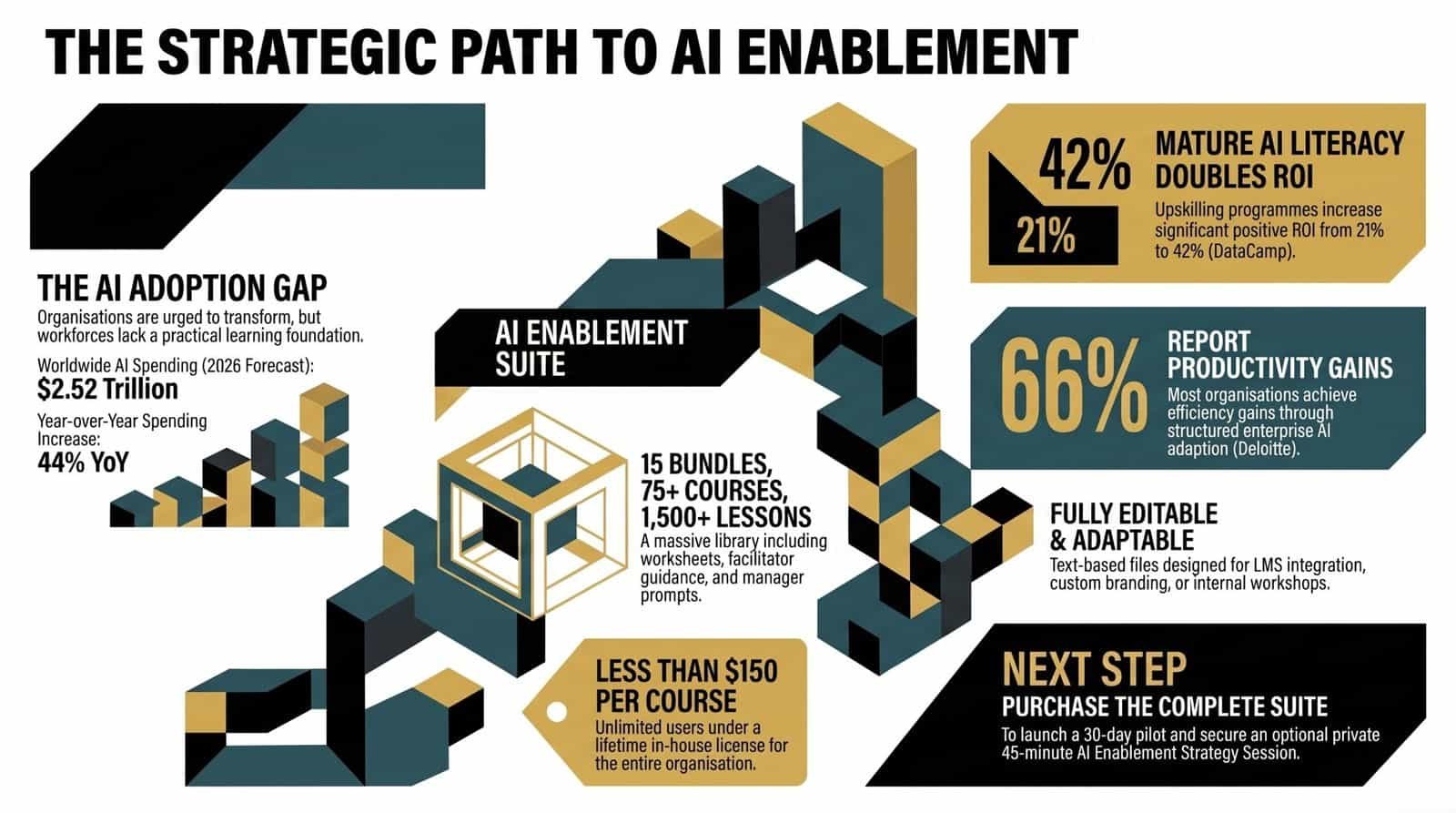
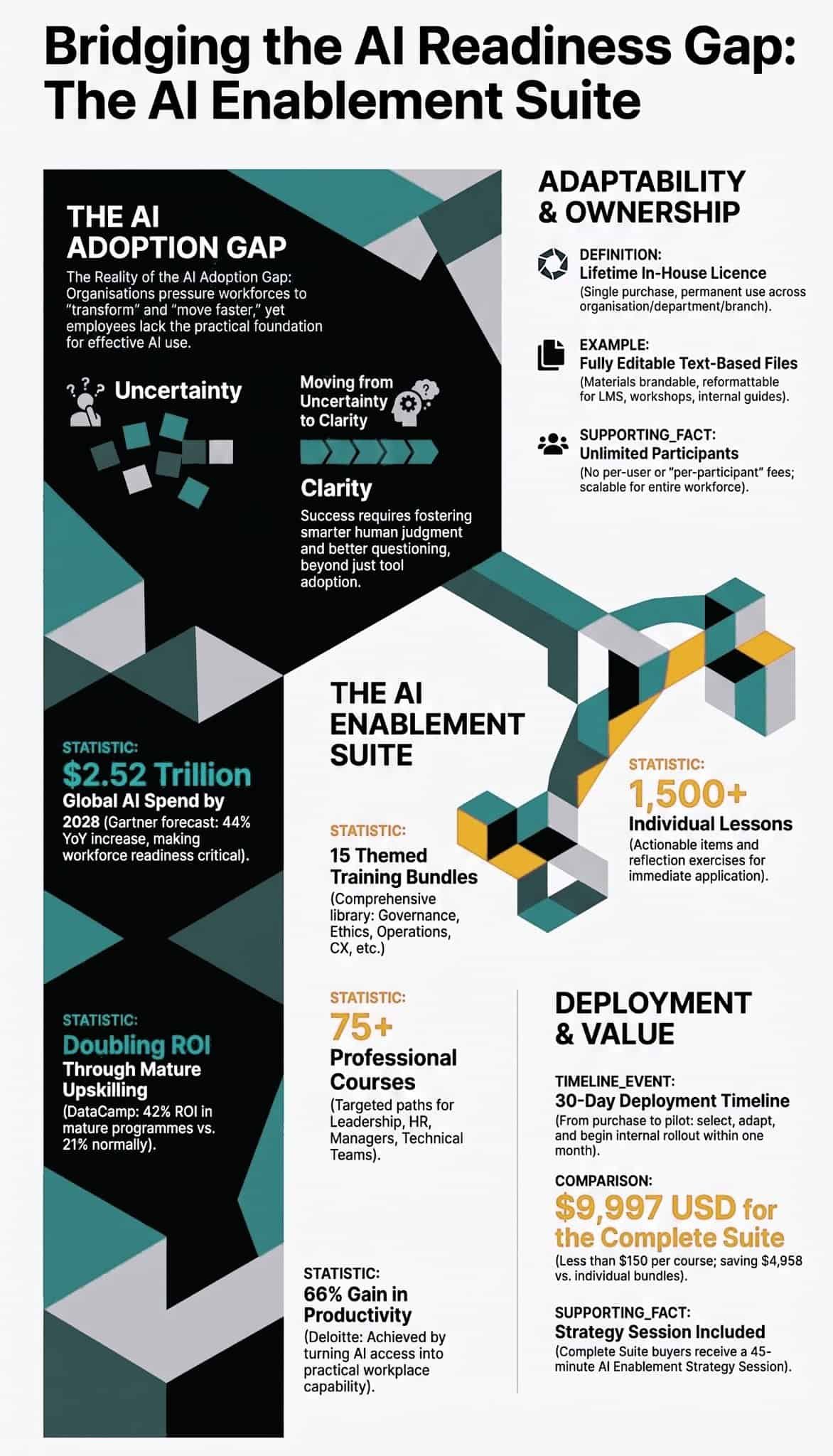
Final note...
...and above all, enjoy the process!
This has all been developed as a multiple-win for all parties - and for the 'humans' to celebrate being human and feeling empowered as we adopt AI into every facet of life.
With an abundance of appreciation,